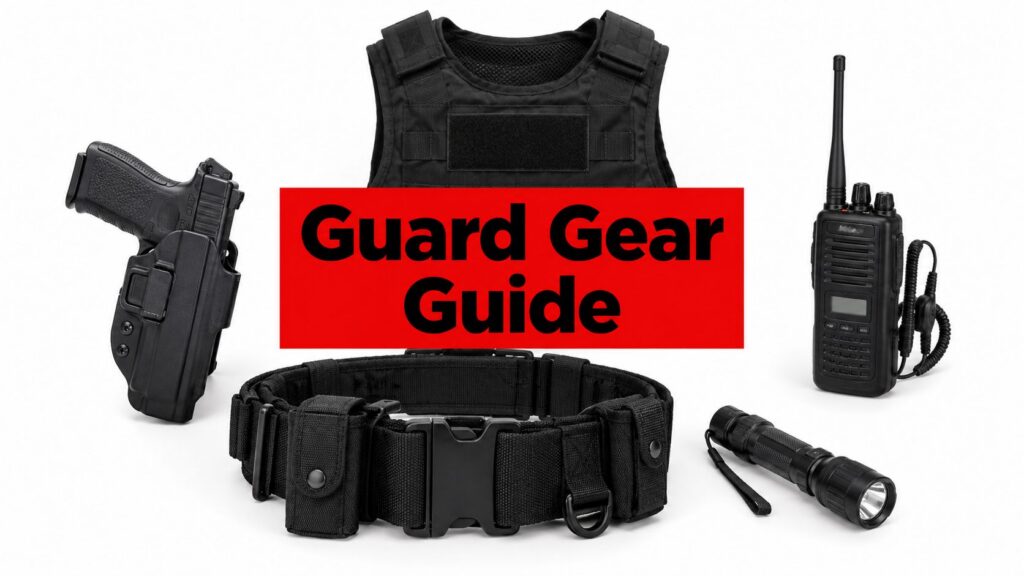
A property manager can walk a post and see everything that looks reassuring: a holstered sidearm, body armor, a radio, restraints, and a polished uniform. What that visible kit won't tell you is whether the officer is authorized to carry that firearm, whether the caliber matches the permit, whether the armor was inspected, or whether the equipment actually belongs on that assignment.
That gap matters. Armed security guard gear isn't a shopping list. It's a documented connection between the officer, the post orders, the site threat assessment, the training record, and the equipment issued for the shift. A premium loadout with weak records is difficult to defend. A properly authorized, inspected, and site-appropriate setup is far more useful to a property manager responsible for safety, compliance, and service quality.
Why Armed Security Guard Gear Starts with Authorization
A manager overseeing a retail center in Los Angeles may see an armed officer positioned at the entrance and reasonably assume the provider has completed the necessary checks. That assumption is unsafe. The manager needs to know whether the officer holds the required California credentials, whether the firearm is authorized for the officer, and whether the assigned equipment matches the written duties at that property.
California treats armed security work as a regulated responsibility, not an ordinary extension of an unarmed post. A guard who carries a firearm during employment must complete firearms and use-of-force training, and armed status requires documentation beyond the presence of a weapon. California's firearms training materials also distinguish security guards from peace officers. An armed guard does not automatically have police authority because the officer carries a firearm. California's firearms training materials explain that distinction and the related training framework.
That distinction should shape the manager's audit. Ask the provider to connect four records:
- The officer's identity: Confirm the security guard registration and firearms permit belong to the person assigned to the post.
- The firearm configuration: Verify the caliber listed on the permit matches the caliber carried during the shift.
- The assignment: Check that post orders define the officer's authorized duties, escalation limits, reporting obligations, and equipment.
- The inspection trail: Confirm supervisors record condition checks, storage, issuance, and any equipment change.
Practical rule: If the provider can show you the gear but can't show you the authorization and inspection record behind it, the audit is incomplete.
A useful starting point is Overton's armed security guard requirements, but the principle applies to any California security vendor. The provider should be able to explain who verifies credentials, who approves substitutions, and what happens when an officer reports for duty with a different firearm, holster, or armor configuration.
This approach also prevents a common staffing mistake. A property manager may request “armed coverage” without first deciding whether the property needs an armed security officer, an unarmed officer, mobile patrols, or a different response model. California rules distinguish proprietary private security officers as unarmed and restrict them from carrying firearms, batons, or other deadly weapons. The applicable California regulation makes role classification part of the equipment decision.
Licensing, Training, and Firearms Qualification Rules
California armed coverage begins with two separate credentials. The officer must hold a valid BSIS security guard registration and a valid BSIS firearms permit. While carrying on duty, the officer must have the firearms permit in possession, and the firearm must be a caliber for which the officer qualified and that appears on the permit. The BSIS firearms manual sets out the connection between the permit, the qualified caliber, and duty carry.
Property managers should review the process in a clear sequence.
Start with the credentials
First, verify the guard registration and firearms permit. Then confirm that the permit is current and that the caliber listed matches the firearm issued for the assignment. A replacement officer cannot arrive with a different caliber just because that weapon is available in the company armory.
California also requires security guard registrants to complete at least 32 hours of security-officer-skills training within six months after initial registration. That requirement is separate from firearms qualification and reinforces a basic operational point: a weapon does not establish competence, authority, or appropriate judgment. California's powers-of-arrest and training document provides the relevant framework.
Verify how qualification occurred
The firearms permit process includes a BSIS course at a Bureau-approved firearms training facility with a Bureau-approved instructor. The applicant must pass a written examination and qualify on the range with the caliber carried on duty. An initial applicant must also complete an assessment addressing judgment, restraint, and self-control within the relevant application period. BSIS describes the firearms permit process, including the approved training and qualification requirements.
The compliance file should therefore contain more than a permit photocopy. It should connect the officer's name, permit, qualified caliber, training record, use-of-force instruction, and assignment.
Track recurring qualification
Qualification doesn't end after the initial permit process. BSIS rules require permit holders to pass range qualification on two separate occasions at least four months apart during each 12-month period before permit expiration, with at least one qualification using live ammunition. The qualification must use a caliber listed on the permit. The BSIS rules on firearms qualification establish those recurring requirements.
A manager doesn't need to select weapons or grade range performance. The manager does need a reliable verification process. Ask for current qualification dates, the caliber used, permit expiration information, and the provider's method for removing an officer from armed duty when a qualification lapses.
Private security officer training information from Overton can help frame the broader training conversation, but the contract should require the provider to produce its own current records. The firearm, the permit, and the qualification record should always be treated as one credential chain.
Core Equipment Categories Tied to Post Orders
A duty firearm belongs in the equipment plan only after the assignment has defined when the officer may carry it, where it must remain secured, and what response the officer is expected to provide. The same principle applies to every other item. Post orders should explain why the officer carries the equipment, not merely list what the uniform looks like.
Build the equipment record around the post
The Statement of Conditions should identify the site hazards, access points, patrol areas, lighting conditions, communication needs, and response expectations. The post orders then translate those conditions into equipment requirements.
A practical record can map each item this way:
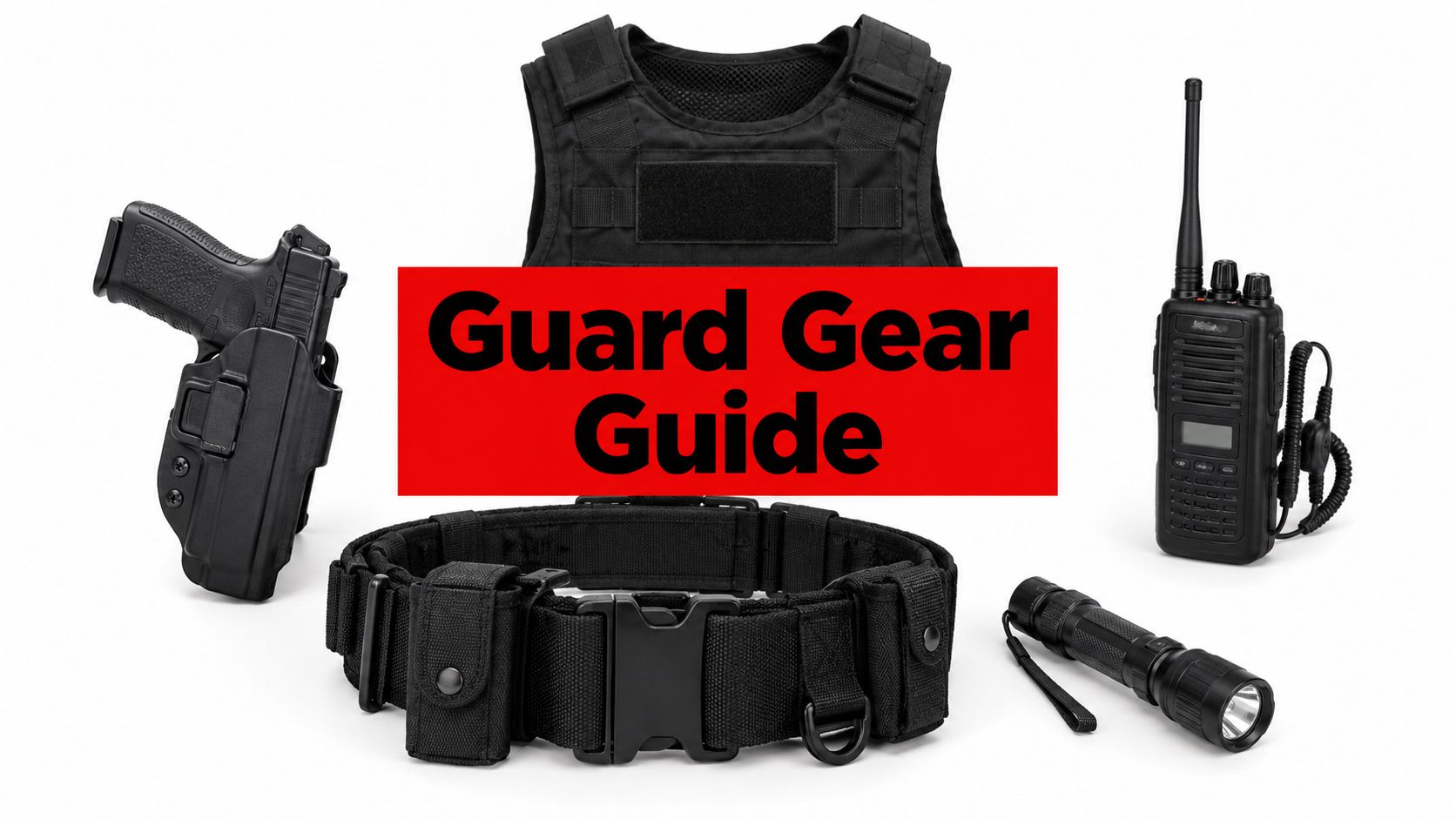
- Firearm and holster: Record the authorized firearm configuration and use a retention holster appropriate to the assignment. The holster should remain secure during walking, vehicle entry, stair use, and routine contact with visitors.
- Ammunition and magazine carriers: Match ammunition and magazines to the authorized firearm and document issuance, storage, and return. Don't allow an informal swap between officers.
- Armor and load-bearing platform: Specify whether the post requires concealed or overt armor, how it must fit under or over the uniform, and whether the officer can move through the property without obstruction.
- Radio and phone: Test communication with the supervisor, dispatch function, and site contacts. A radio that can't reach the responsible channel is decorative equipment.
- Flashlight and identification: Select lighting for the patrol environment and ensure the officer can identify themselves clearly in low light.
- Restraints, OC spray, and less-lethal tools: Issue only what the officer is authorized and trained to carry, with post orders defining reporting and storage requirements.
- Incident reporting tools: Provide the phone, notepad, camera, or reporting application required to document activity without delaying an emergency response.
Overton's operational materials describe equipment such as duty belts, radios, cell phones, and other items determined by post requirements. That post-specific approach is more defensible than issuing the same kit to a lobby officer, a construction-site patrol officer, and a warehouse-yard officer.
Make every item visible in the accountability system
The Guard Tracking Management System should record checkpoint activity, patrol completion, photos, and equipment-related exceptions. The Daily Activity Report should capture damage, missing equipment, unusual use, battery failures, and any change made during the shift.
A shared workspace can also help teams coordinate handoffs, policies, and incident information. Property managers evaluating options may find a security platform for hybrid teams useful as a general reference, especially when site personnel, supervisors, and client contacts work across different locations.
The manager's audit question is simple: Can the provider show why this item was issued, who had it, whether it worked, and what happened when it was used? If the answer is yes, gear supports accountability. If the answer is no, the equipment list is just an inventory.
For guidance on translating site conditions into usable instructions, see how to write security post orders. Good orders define decisions before an incident forces an officer to improvise.
Body Armor and Hearing Protection Trade-Offs
More protection isn't automatically better. A rigid rifle plate can add substantial load and restrict movement, while a bulky carrier can make vehicle entry, stair climbing, restroom access, and prolonged patrols more difficult. The correct armor is the configuration that addresses the documented threat while allowing the officer to perform the actual job.
The current NIJ 0101.07 framework separates soft armor into HG1 and HG2 handgun categories and hard armor into RF1, RF2, and RF3 rifle categories. Testing evaluates both projectile perforation and behind-armor blunt trauma. A procurement file should identify the exact tested model, NIJ protection category, coverage area, fit, and certification status. The material name alone is not enough. NIJ's 0101.07 standard explains the performance framework and its role as a minimum test standard.
For a public-facing lobby in a Class A office building, concealed or low-profile soft armor may support mobility and a calm customer-service posture. A higher-risk post may justify rigid rifle-rated protection, but that decision belongs in the threat assessment, not in a catalog comparison.
| Category | Level / Rating | Best Fit | Trade-Off |
|---|---|---|---|
| Soft armor | HG1 or HG2 | Posts where handgun threats are the documented concern | More wearable, but it doesn't address rifle categories |
| Hard armor | RF1, RF2, or RF3 | Posts with a documented rifle threat | More rigid and burdensome, with greater mobility and fatigue concerns |
| Hearing protection | Communication-compatible, properly fitted protection | Firearms qualification and incident environments involving impulse noise | Poor fit can reduce communication and awareness |
Hearing protection deserves the same discipline. OSHA identifies 140 dB SPL as the upper limit for impulse-noise exposure, while NIOSH recommends an 85 dBA eight-hour time-weighted exposure limit using a 3 dB exchange rate and no exposure above 140 dB. NIOSH materials report that firearms-related impulses can exceed 170 dB SPL, so ordinary passive protection may be inadequate in some training or indoor-range environments. NIOSH's firearms noise report provides the cited exposure guidance.
Use electronic level-dependent earmuffs when communication, alarms, radio traffic, and verbal commands must remain available. During qualification or indoor-range work, employers may combine muffs and plugs. NIOSH advises adjusting labeled attenuation when subject-fit data aren't available by subtracting 25% from earmuff NRR and 50% from formable earplug NRR. Dual protection can add approximately 5 to 10 dB of attenuation, according to the same report.
For custom-fit options, a resource such as custom earplugs in Boca Raton may help illustrate the difference between nominal product ratings and fit-specific protection. The operational test remains practical: can the guard hear the radio, recognize an alarm, understand a command, and protect hearing during the activity?
Inspection, Maintenance, and Replacement Discipline
A provider should never rely on an officer saying that equipment “looks fine.” Inspection records should identify the item, assigned serial number where applicable, inspection date, condition, corrective action, and approving supervisor.
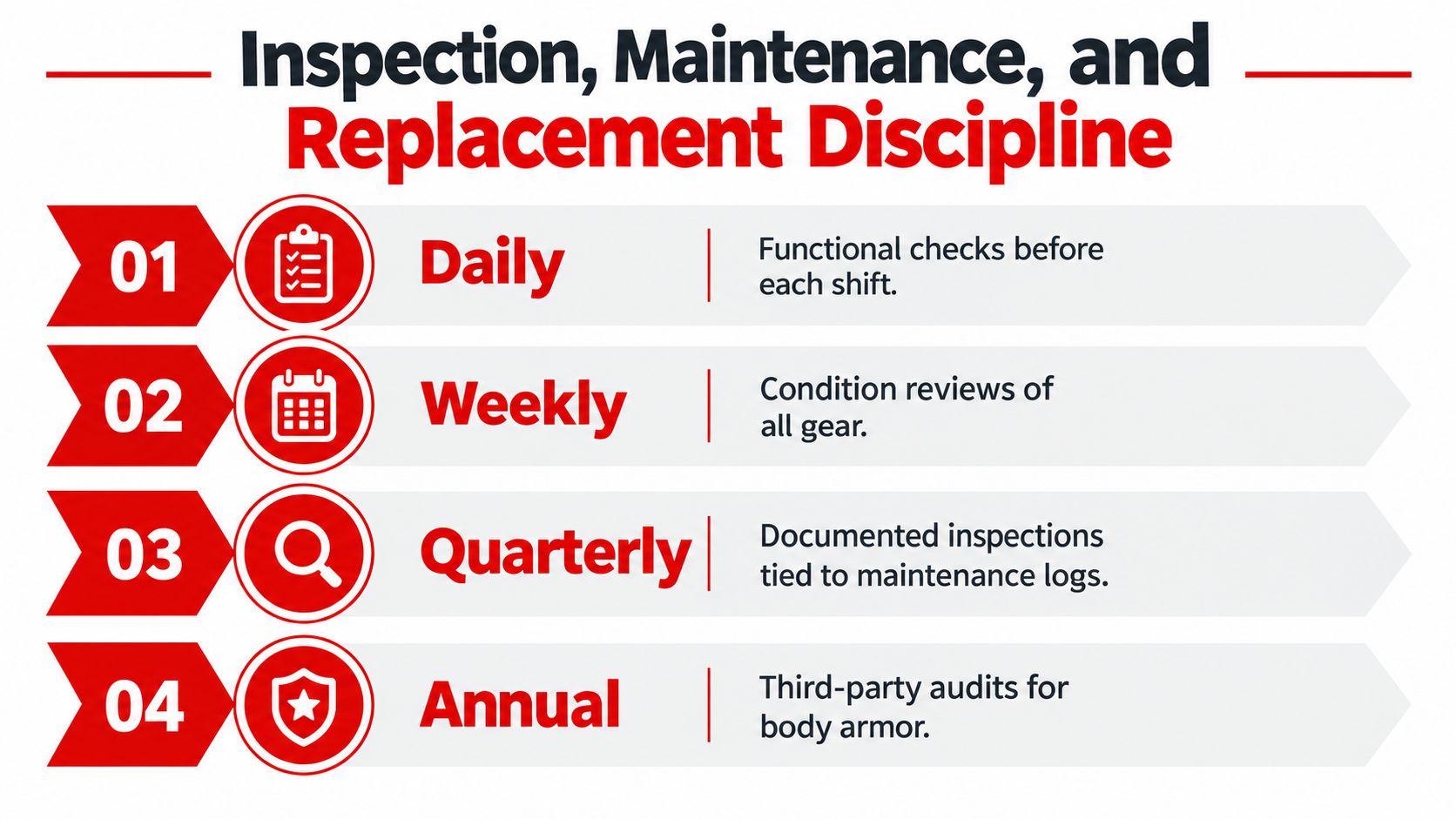
The cadence should be easy for a manager to audit:
- Daily: Complete functional checks before each shift. Test radio operation, battery condition, flashlight function, holster retention, restraints, phone access, and visible equipment damage.
- Weekly: Review the condition of issued gear across the team. Look for worn stitching, cracked carriers, loose fasteners, damaged cords, compromised seals, and equipment that officers have stopped using because it's uncomfortable.
- Quarterly: Tie documented inspections to maintenance logs. Record serial numbers, assigned officers, deficiencies, repairs, and return-to-service approval.
- Annual: Use third-party review where appropriate for body armor and communications equipment. An outside check can identify problems that routine users have normalized.
Define replacement triggers before failure
Follow the manufacturer's service-life instructions for armor panels and carriers. Replace armor after a ballistic event, visible damage, compromised protective material, or the end of the manufacturer's rated service life. Don't return a panel to service because the carrier still looks presentable.
Holsters with visible polymer fatigue, broken retention components, or damaged attachment points should come out of service immediately. Radios should be replaced or repaired when they fail antenna checks, battery-cycle tests, charging checks, or communication tests required by the provider's maintenance program.
Firearms and other sensitive items require chain-of-custody records whenever they leave the property or armory for service. Record who released the item, where it went, why it went, and who accepted it back. A manager should be able to establish that the item was authorized, functional, correctly stored, and assigned at the time of an incident.
A reliable paper trail turns an equipment claim into something a client, investigator, or insurer can verify.
Matching Gear to Site, Climate, and Public Role
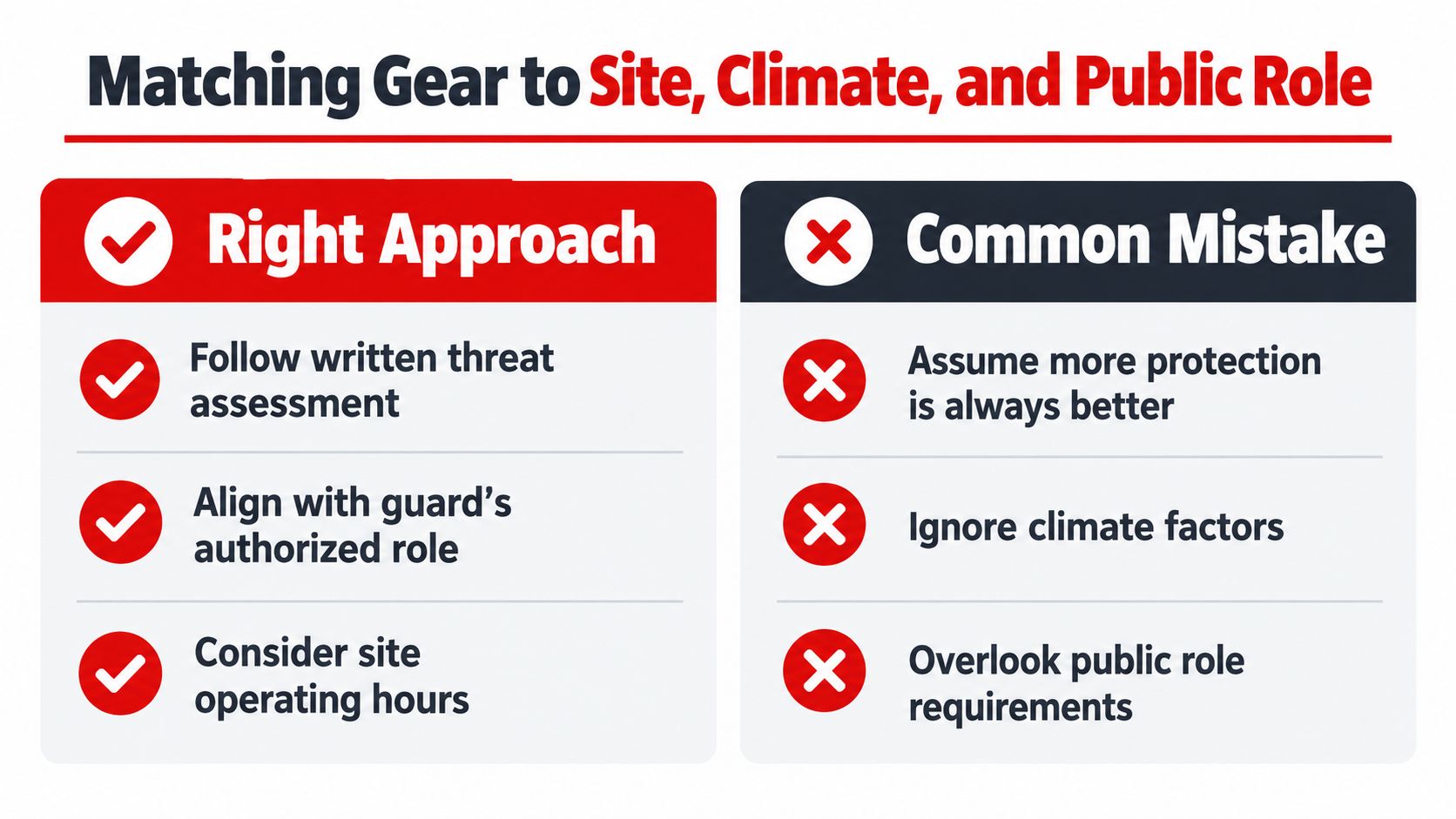
The safest kit is not the heaviest kit. It's the one that lets an authorized officer perform the assigned duties without unnecessary heat, fatigue, obstruction, or public confusion.
A uniformed officer at a residential high-rise lobby has a different job from an officer patrolling a dark construction yard. The lobby officer may need discreet communications, comfortable soft armor, visible identification, and a presentation that supports calm interaction with residents and guests. The construction officer may need weather-resistant outerwear, strong low-light identification, gloves that preserve control, and equipment that remains secure while moving around unfinished surfaces.
Assess the role before selecting the carrier
Start with the written threat assessment and post orders. Ask:
- What must the officer do repeatedly? Standing at a reception desk, walking a parking structure, checking loading docks, and responding to access alarms create different physical demands.
- How visible should the equipment be? Visible armor may reinforce deterrence at a high-risk perimeter. Discreet equipment may be more appropriate where customer interaction and de-escalation dominate.
- What does the climate require? Hot regions may call for moisture-wicking base layers beneath a carrier. Cold sites may require insulated outerwear that doesn't interfere with the holster or radio.
- What does the uniform permit? Gloves, footwear, rain gear, and high-visibility clothing must preserve movement, identification, and safe equipment access.
- What role is legally authorized? Don't issue firearm-related equipment to a role that isn't authorized to carry a firearm.
Vehicle patrol in Los Angeles, retail security in San Jose, and healthcare security in San Diego can all involve different visibility and mobility requirements. A hospital lobby may prioritize communication, patient interaction, and controlled restraint. A warehouse yard may prioritize weather tolerance, lighting, and dependable radio coverage.
A manager should reject generic “tactical” specifications that don't explain the operational reason for each item. Maximum protection can become a liability when it makes the officer slower, less approachable, less comfortable, or unable to complete the patrol. The final equipment list should read like a deliberate response to the site, not an aspirational catalog.
Procurement Checklist and Common Audit Questions
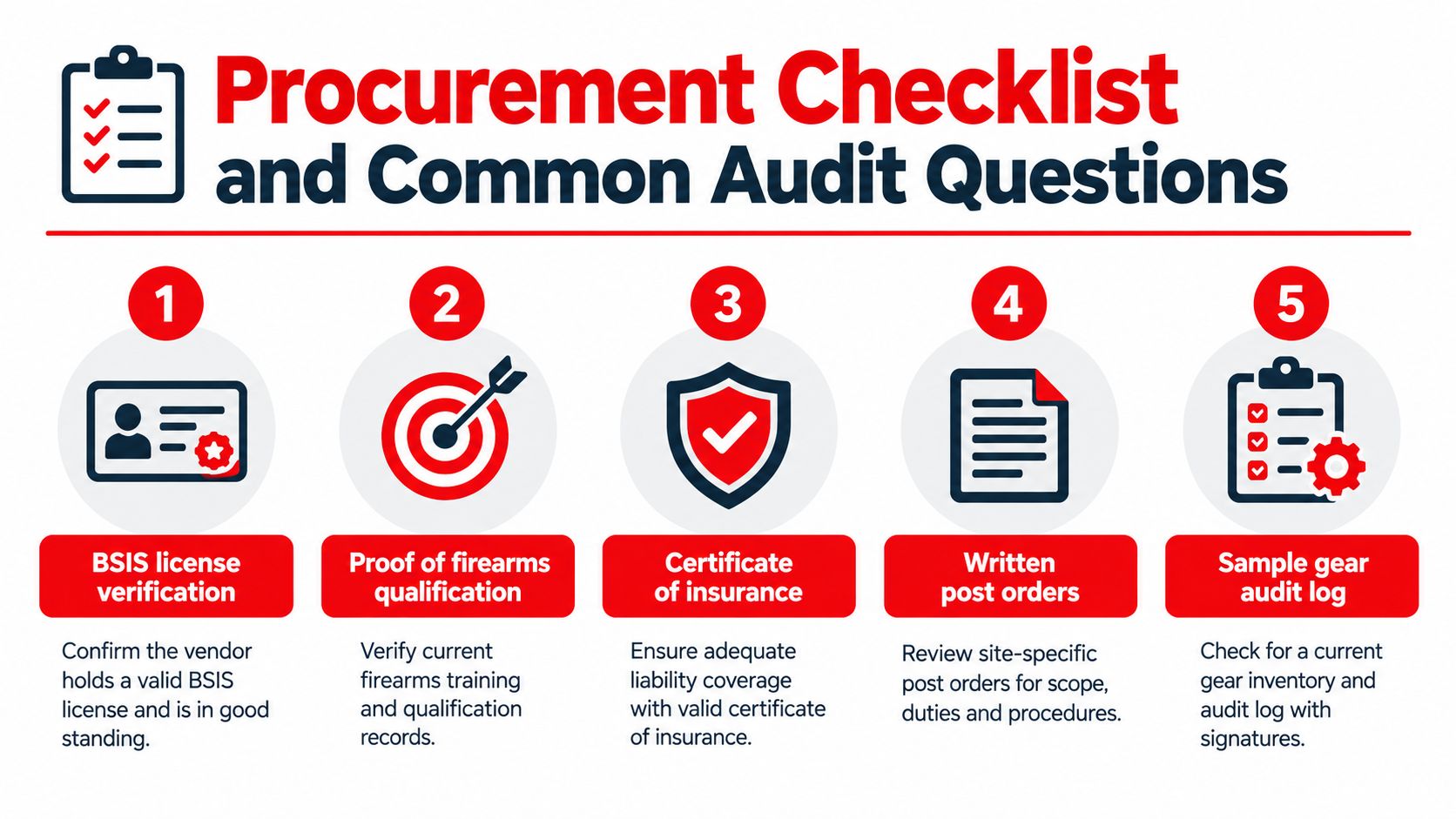
Before signing an armed-security contract, ask the provider to answer each item with a document, not a verbal assurance.
Complete the pre-contract review
- License verification: Has the provider supplied evidence of current BSIS registration and firearms permits for officers assigned to armed posts?
- Firearms qualification: Does the record show the qualified caliber, written and range requirements, recurring qualification dates, and live-ammunition qualification where required?
- Certificate of insurance: Does the provider's insurance documentation match the contract, site risk, and requested duties?
- Written post orders: Do the orders define patrol areas, access control, escalation, equipment, reporting, storage, and substitution procedures?
- Sample gear audit log: Can the provider show a sample record linking issued equipment to serial numbers, inspections, repairs, and replacement decisions?
Treat the checklist as an operational deliverable. It should help you manage a substitute officer, investigate a missing radio, confirm an armor inspection, or determine whether a firearm configuration was authorized on a particular shift.
Questions auditors actually ask
Who owns the duty ammunition?
The contract and provider procedures should identify ownership, storage responsibility, issuance controls, and return requirements. The record should show who issued it and to which authorized firearm configuration.
How often are firearms requalified?
California requires range qualification on two separate occasions at least four months apart during each 12-month period before permit expiration, with at least one qualification using live ammunition. Verify the dates, caliber, and responsible supervisor in the compliance file. The governing BSIS qualification rules should be part of the provider's review process.
Where are body-armor certifications stored?
The provider should retain the tested model, protection category, coverage information, fit records, inspection history, and manufacturer care instructions. The site manager should know how to request those records without relying on an officer's memory.
How are use-of-force incidents documented?
The provider should explain how the officer reports the event, how the supervisor reviews it, and how the SOC and GTMS preserve time-stamped activity, photographs, communications, and follow-up actions. A Daily Activity Report alone may not be enough for a serious incident.
What triggers replacement?
The answer should include ballistic impact, visible damage, failed inspection, manufacturer service-life limits, unsafe holster wear, communication failures, and any defect that prevents the officer from performing the post safely.
A vendor that welcomes these questions demonstrates operational maturity. A vendor that treats documentation as an inconvenience is asking the property manager to accept risk without visibility.
Overton Security provides armed and unarmed officers, customized post orders, GPS-enabled patrol tracking, digital daily activity reports, and 24/7 SOC oversight tied to documented accountability. Visit Overton Security to discuss a site-specific armed security program and request a practical gear, credential, and inspection review for your property.