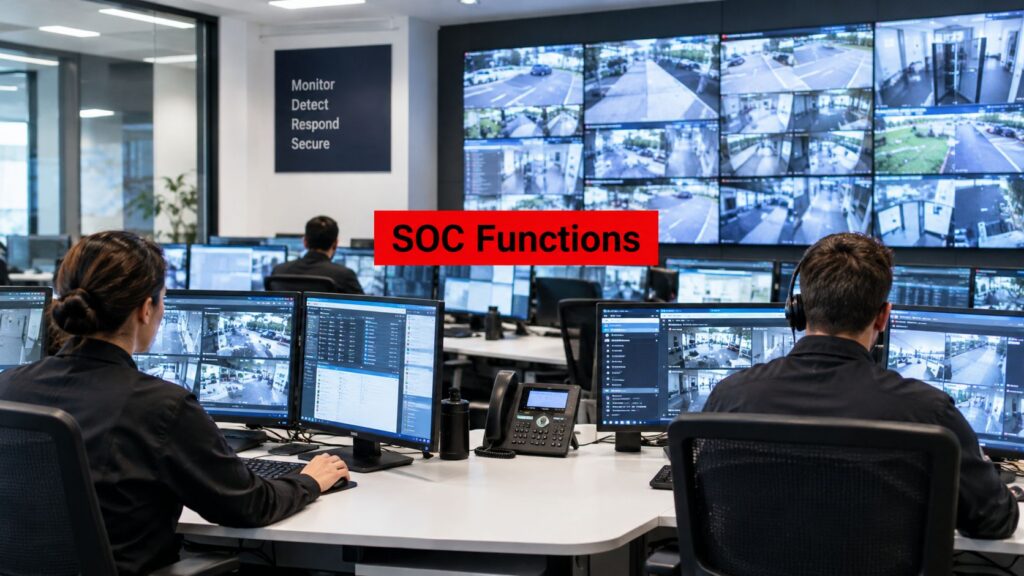
A property manager rarely sees the full security operation behind a single alert. You see the result, perhaps a patrol officer at a gate, a camera clip in an email, or a report waiting after sunrise. At 2:14 a.m., however, a glass-break alarm at a closed retail center can set several people and systems into motion.
The signal reaches a remote operator, who checks the alarm details and available video, compares the event with access activity, and decides whether it appears genuine. If the evidence supports a response, the operator contacts a mobile patrol unit, provides the location and context, and keeps the event open until the officer reports the outcome. By morning, the property manager should have a time-stamped record showing what happened, who acted, and whether follow-up is needed.
That chain is the practical meaning of security operations center functions. A SOC isn't just a room full of screens or a software subscription. It converts scattered signals into documented, accountable action, a model that also applies to security operations for small businesses. For an overview of how a remote center can support officers, alarms, and property teams, see Overton's 24/7 Security Operations Center.
Why Security Operations Center Functions Matter at 2 A.M.
At 2:14 a.m., a glass-break alarm doesn't explain itself. It doesn't tell an operator whether a storm caused the signal, a cleaning crew entered unexpectedly, or someone forced entry through a vacant storefront. The first function of a SOC is to turn that incomplete signal into a decision.
The remote operator starts with the available facts:
- Signal details: Which panel, zone, door, or sensor reported activity?
- Property context: Is the location normally closed, and is any approved after-hours work scheduled?
- Corroborating evidence: Do cameras show movement, a damaged entry, a vehicle, or nothing relevant?
- Response requirement: Does the event justify a patrol check, a call to the site contact, emergency services, or continued observation?
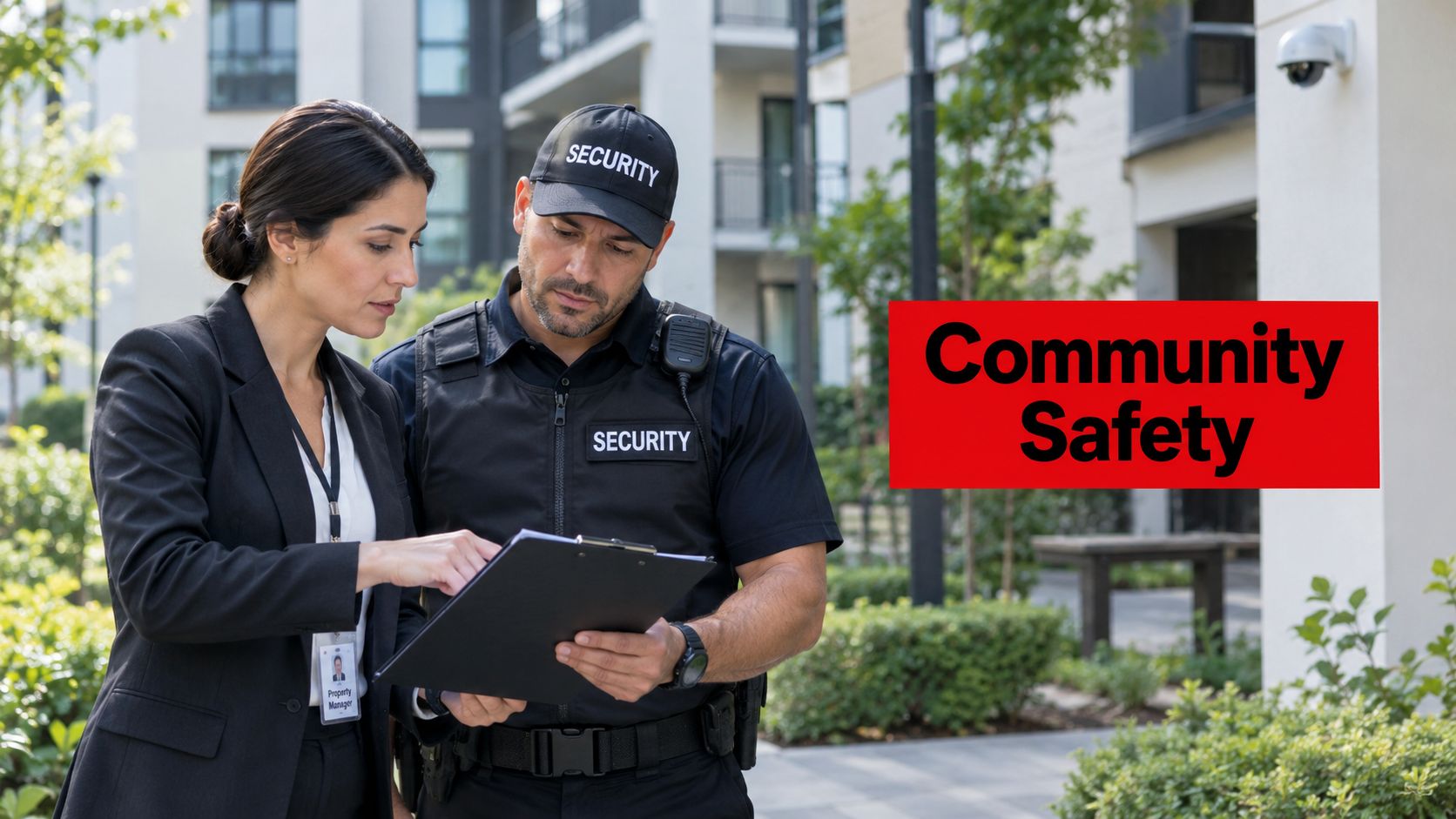
A mobile patrol officer then becomes the physical presence at the property. The SOC doesn't replace that officer. It gives the officer useful information before arrival and remains available to coordinate communications, notify stakeholders, and document the outcome.
Practical rule: An alarm is an input. A validated incident is a decision supported by evidence and a defined response.
This distinction matters for retail centers, apartment communities, construction sites, and office buildings alike. A motion alert in a fenced construction yard may call for a drive-by check. A forced-door event at a residential entrance may require video verification, a building contact, and an immediate officer response. The correct action depends on the signal, the setting, the time, and the consequences of getting the decision wrong.
A reliable SOC also closes the loop. The report should identify the event time, operator actions, dispatch details, officer observations, images or video where available, notifications, and unresolved issues. That record helps a property manager evaluate service quality instead of relying on a vague statement that “the alarm was handled.”
What a Security Operations Center Actually Does
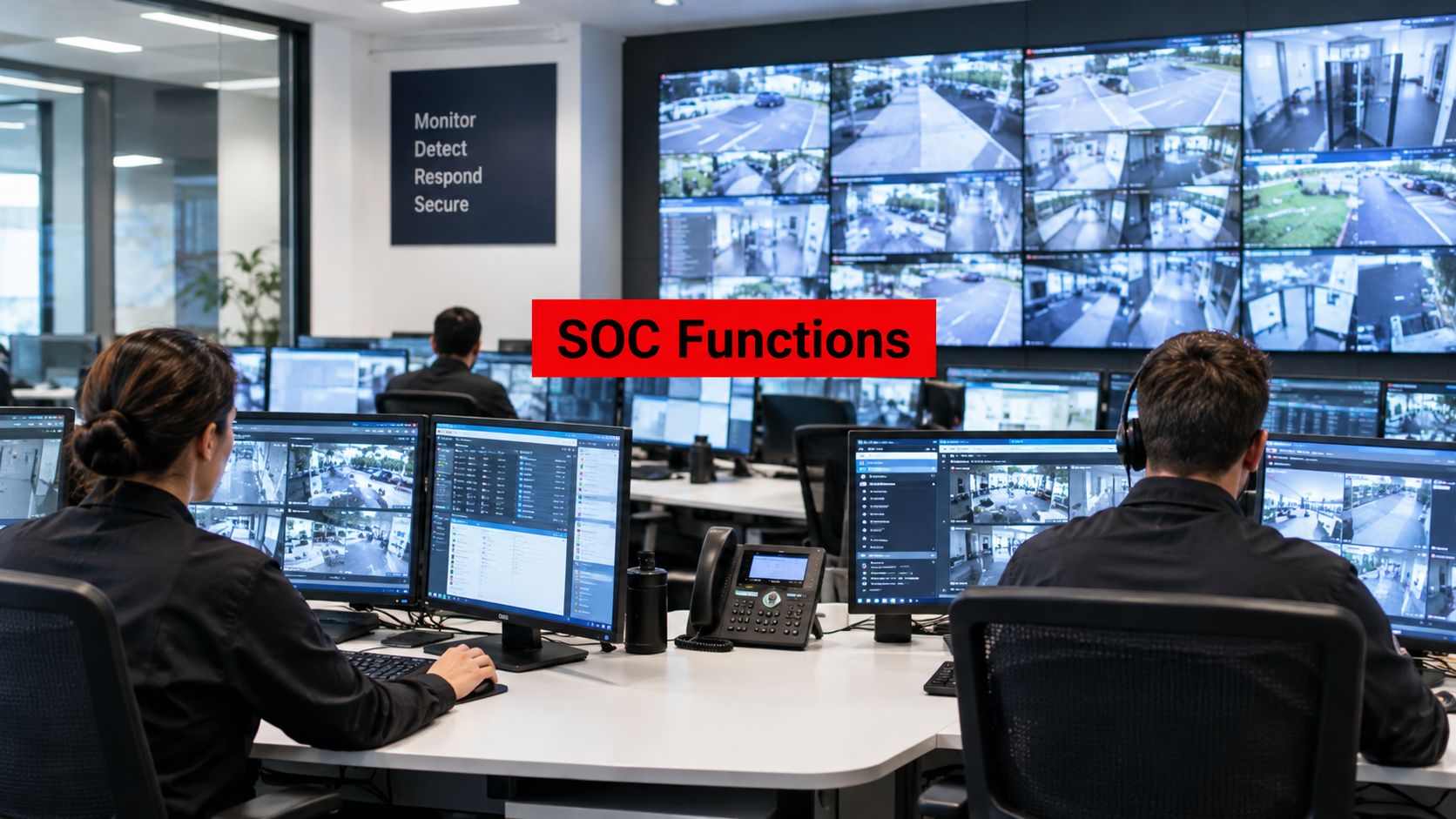
A security operations center combines people, processes, and technology to monitor events, assess their meaning, coordinate a response, and improve future performance. In a physical-security program, the inputs may include video, intrusion panels, access-control activity, officer check-ins, GPS data, emergency calls, and reports from tenants or staff.
A SOC is not just a wall of screens. It also isn't an answering service that forwards every call without judgment. Its value comes from assigning responsibility to each stage of the incident:
- Prepare: Build site instructions, contact lists, post orders, response playbooks, and escalation thresholds.
- Detect and analyze: Receive signals, gather context, verify the event, and determine severity.
- Contain: Limit access to an affected area, send an officer, secure a door, or take another authorized action.
- Eradicate: Remove the immediate cause where the operating model allows it, such as ending unauthorized access or correcting a known process failure.
- Recover: Restore normal operations, confirm system status, and communicate what remains open.
- Learn: Review the incident, identify gaps, and update procedures, training, or technology.
This lifecycle follows the incident-handling model described by NIST's Computer Security Incident Handling Guide. NIST also recommends measuring elapsed time from incident onset through discovery, impact assessment, containment, recovery, and the initial response, along with analyst labor. Those ideas translate well to physical security because a property team also needs to know how quickly an event was noticed, acknowledged, verified, contained, and documented.
The difference between cyber and physical operations
A cybersecurity SOC may investigate authentication activity, endpoint behavior, and network events. A physical-security SOC may verify a door alarm, track a patrol officer, review a camera feed, or coordinate a wellness check. The technologies differ, but the operating logic remains consistent:
- Centralize signals so the team sees more than one isolated event.
- Apply consistent triage so urgency isn't determined by whoever happens to answer.
- Escalate according to policy rather than personal preference.
- Record the outcome so the client can review performance and unresolved risk.
Historical experience supports this coordination model. After the Morris worm disrupted a significant portion of the early Internet on 2 November 1988, the first Computer Emergency Response Team, CERT/Coordination Center, was established 15 days later at Carnegie Mellon University. The response functions it institutionalized, including collecting reports, analyzing activity, coordinating technical action, distributing warnings, and helping organizations recover, still resemble the coordinated work expected from modern SOCs. The history is documented in the Oxford Research Encyclopedia chapter on CERT/CC.
A property manager should be able to describe the SOC in one sentence: It receives security signals, decides what they mean, directs the right response, and proves what happened afterward.
Monitoring, Detection, and Triage as Daily Functions
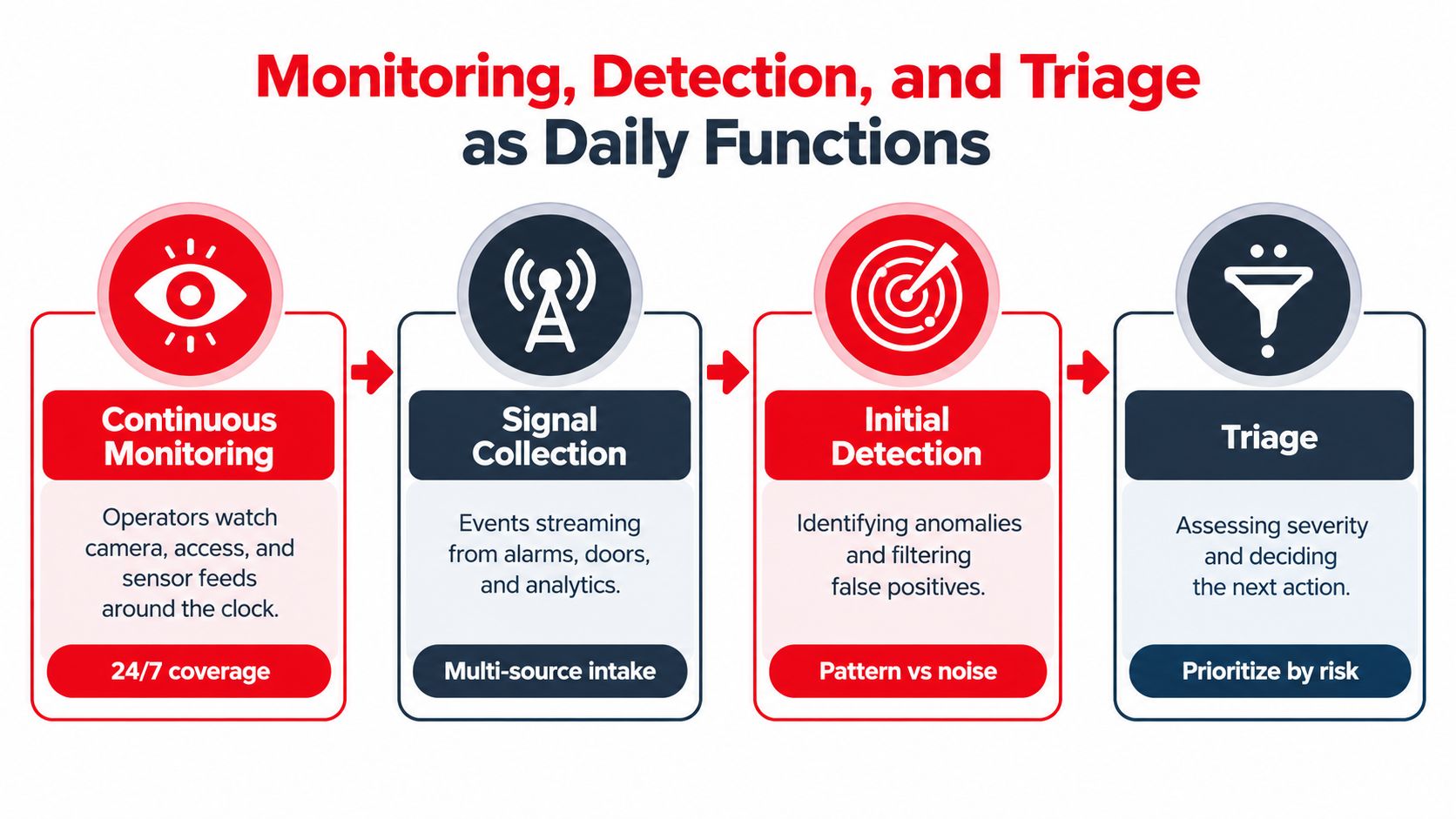
At 2 a.m., a camera alert at one property may coincide with a gate opening at another. The SOC operator's task is to connect those signals, establish what is happening, and decide whether a patrol, call, or escalation is justified.
Daily monitoring can include:
- Camera analytics and live video
- Intrusion-panel alarms
- Access-control events
- Door-held or forced-door notifications
- Officer GPS and guard-tour checkpoints
- Tenant, resident, or staff calls
- Fire-watch and life-safety observations
Each signal needs context. A motion alert in a fenced yard after hours deserves closer review if a gate opened shortly beforehand, video shows someone near stored materials, or a patrol checkpoint was missed. The same alert may be closed when it occurs during an approved delivery window and the operator confirms the activity.
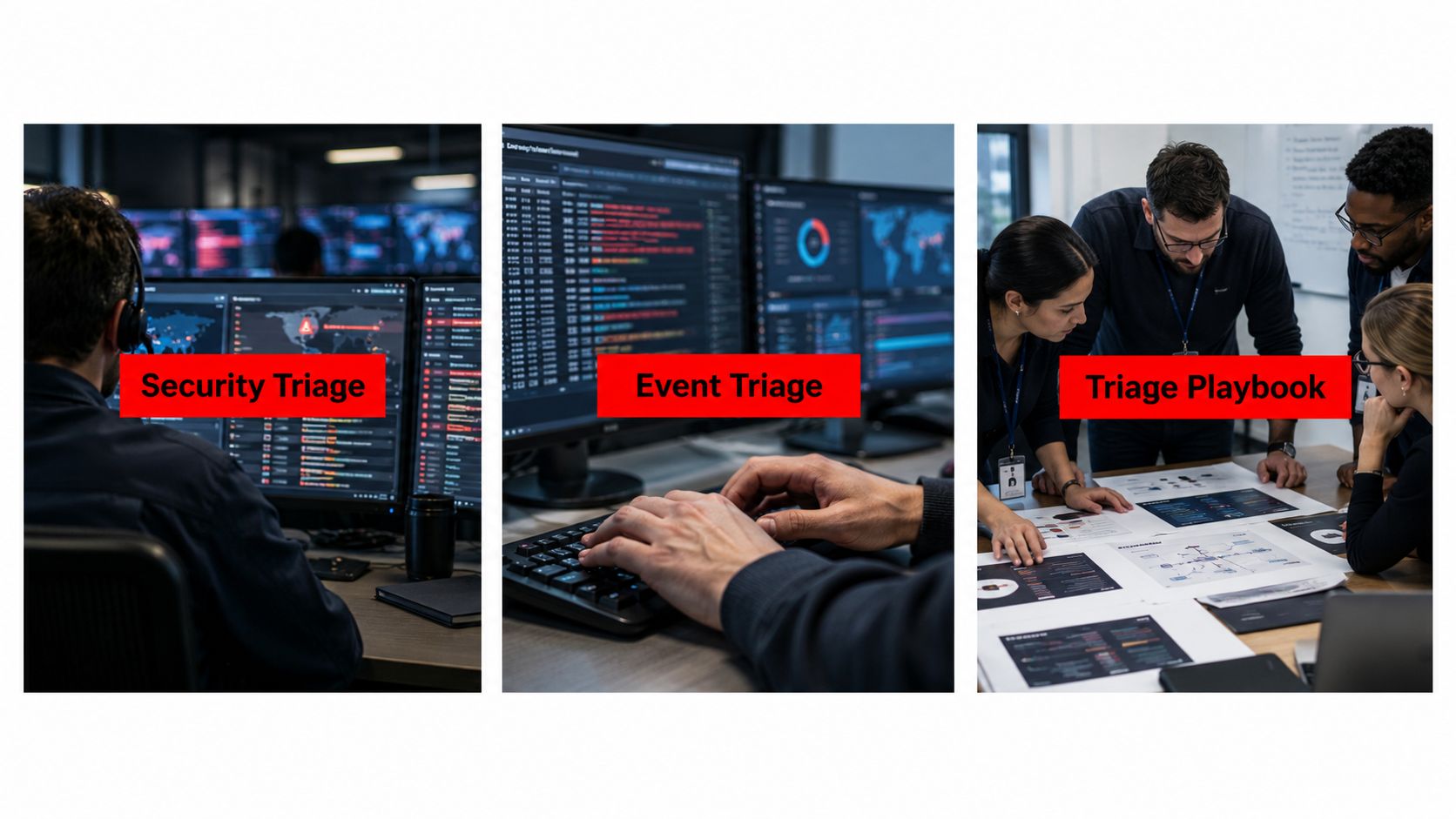
The operator's working question is, “What evidence supports action, and which response matches the risk?” A defined security event triage process gives operators a repeatable way to answer it. That consistency matters across multiple buildings, where similar alarms should receive similar handling regardless of who is on shift.
From alarm to validated incident
An alarm is a technical notification. A validated incident has enough supporting information to justify a response. The distinction affects dispatch volume, officer safety, client notifications, and the accuracy of the incident report.
A forced door at a residential building may generate an access-control alert, a camera view of the entrance, and an observation from an onsite officer. The SOC can compare those inputs, determine whether the door is damaged or merely propped open, and set the priority. Depending on the findings, the operator may dispatch patrol, contact the building representative, request an onsite check, or escalate immediately if someone appears to be at risk.
Poor triage produces two operational failures. Treat every signal as urgent and field resources spend time on avoidable dispatches. Treat every signal as routine and a genuine incident can remain in the queue while conditions worsen. Analysts cited in the 2025 global SOC research reported by PR Newswire found that 88% of SOC leaders experienced rising alert volume, 46% reported increases above 25%, and 76% identified alert fatigue as a top challenge. In a physical-security program, the same pressure appears as repeated motion alerts, nuisance door alarms, and unverified access events.
Property managers should ask:
- Staffing coverage: Who handles signals overnight and during shift changes?
- Verification standards: What evidence must an operator collect before dispatch?
- False-positive handling: How are repeated nuisance alarms reviewed and tuned?
- Decision records: Can the client see why an event was closed, dispatched, or escalated?
A capable SOC measures whether operators consistently identify events that warrant action, not just how many alarms they process.
Dispatch, Response Coordination, and Escalation Workflows
Dispatch begins after triage, but it isn't merely a phone call. The SOC must select the responder, communicate the location and known facts, set expectations, and keep ownership until the incident reaches a defined endpoint.
Consider a vehicle detected inside a closed construction site after midnight. The operator reviews the camera view, confirms the vehicle is within the restricted area, and checks whether an authorized contractor should be present. If no legitimate explanation exists, the operator contacts the assigned patrol officer or onsite guard, shares the access point and direction of travel, and records the time of dispatch.
The field officer's job is to observe, deter, check conditions, and follow the approved site procedure. The SOC's job is to maintain the operational picture, coordinate communications, notify authorized contacts, and escalate when the facts meet the threshold. Separating those roles prevents confusion. The officer shouldn't have to decide alone whom to call while approaching an uncertain scene, and the operator shouldn't pretend to conduct the physical inspection remotely.
Escalation needs written thresholds
A practical escalation matrix defines who acts at each severity level. It should account for verified evidence, life safety, active intrusion, property damage, vulnerable occupants, business disruption, and the availability of onsite personnel.
A matrix might specify:
- Field response: Patrol or onsite officers check the location and report conditions.
- Supervisor support: A supervisor joins when the scene is complex, the officer requests assistance, or the event affects multiple areas.
- Property notification: The manager, HOA representative, facilities lead, or construction superintendent receives an update according to the agreed contact order.
- Emergency response: Police, fire, medical, or other emergency services are contacted when the circumstances meet the client's policy and applicable emergency requirements.
Fallback communication matters. If a primary phone line fails, the team needs an alternate contact method and a known procedure for documenting the failure. Multi-site programs also need current contact lists, clear site identifiers, and instructions that distinguish one property from another.
For a detailed explanation of how a provider can structure this chain, see Overton's incident response process. A mature program doesn't escalate every uncertain event reflexively. It uses evidence and policy to protect people, preserve options, and keep stakeholders informed.
Remote Video Verification, Alarm Management, and Reporting
Remote video verification gives an operator a way to test an alarm against visual context before sending a field resource. The operator may review live footage, recorded clips, camera position, access activity, and recent operator notes. The purpose isn't to make a perfect judgment from a screen. It's to improve the information available to the person who responds.
A good verification protocol identifies what the operator checks and what happens when video is unavailable. If a camera shows an unknown person at a rear door, dispatch can include that detail. If the camera is offline, the operator should record the limitation and follow the alternate procedure instead of treating missing footage as proof that nothing happened.
Alarm management also includes routine exceptions that can create unnecessary noise:
- Opening and closing exceptions: Confirm whether a door opened outside the approved schedule and whether an authorized person should be present.
- After-hours activity: Compare activity with work orders, deliveries, resident access, events, or contractor schedules.
- Signal restoration: Record when a device returns to service and whether the interruption created a coverage gap.
- Repeated nuisance events: Identify patterns and route them for sensor maintenance, procedural review, or rule adjustment.
Reporting closes the operational loop. A useful daily activity report should show the property, event time, signal type, verification steps, dispatch details, officer observations, photographs where relevant, notifications, and status. “Alarm received and checked” leaves too many questions unanswered.
Overton's GPS-enabled Guard Tour Management System, or GTMS, illustrates the type of documentation a client should expect from a technology-supported program. Officers can scan NFC checkpoints, complete digital Daily Activity Reports, upload photographs, and document incidents in real time. The technology matters because it connects activity to time and location, but the report still needs a human explanation of what the officer found and what remains unresolved.
Analytics, Continuous Improvement, and What to Measure
A SOC improves when it studies the delay and friction inside its own workflow. NIST recommends tracking elapsed time across incident stages, and those measures translate directly into property operations.
The most useful metrics include:
- Mean time to detect: How long it takes for the team to identify a relevant event.
- Mean time to acknowledge: How long it takes an operator to take ownership.
- Mean time to contain: How long it takes to limit the event or stabilize the situation.
- False-positive rate: How often alerts produce no meaningful security concern.
- Escalation compliance: Whether qualifying incidents reached the required responder.
- Documentation completion: Whether reports contain the required evidence and follow-up status.
- Recurrence rate: Whether the same problem returns after remediation.
IBM's 2025 global breach study reported an average of 241 days to identify and contain a breach, consisting of 181 days to identify and 60 days to contain, and reported that extensive use of AI and automation shortened that lifecycle by an average of 80 days compared with organizations that didn't use those capabilities. The IBM Cost of a Data Breach Report concerns cybersecurity, but the operating lesson applies to physical security: time between signal, decision, action, and recovery deserves measurement.
A better monthly review
Incident counts show workload, not necessarily quality. The SANS 2026 SOC report states that incidents handled were the top reported SOC metric for 10 consecutive years and were cited by 70% of respondents. That count should be paired with response quality and outcome measures.
| Metric | What It Measures | Why It Matters |
|---|---|---|
| Mean time to acknowledge | Operator ownership after a signal arrives | Shows whether the queue is actively managed |
| Mean time to contain | Time from validation to stabilization | Indicates how quickly risk is limited |
| False-positive rate | Alerts closed without a genuine incident | Reveals noise, poor configuration, or weak triage |
| Escalation compliance | Qualifying events routed correctly | Tests whether policy works during pressure |
| Recurrence rate | Repeat events after corrective action | Shows whether the underlying issue was addressed |
For staffing context, the 2025 SANS SOC survey reported that teams of 2 to 10 people were the most common SOC size and identified 10 full-time equivalents as a practical planning starting point for monitoring, incident response, threat intelligence, and engineering. A physical-security program may scale that model differently, but every required function still needs an owner and reliable coverage.
Common Misconceptions About SOC-Backed Security Programs
More cameras automatically mean more security. Cameras provide visibility, not a response. At a multi-site property, an operator must reach the right feed, understand whether activity is routine, and give dispatch useful details. Adding cameras without staffing, coverage rules, and review procedures can increase the queue without improving protection.
AI replaces operators. AI can classify video events, connect related alarms, and reduce repetitive review. A person still decides whether the subject is a resident, contractor, officer, or unknown individual, and whether the situation calls for observation, a call, or dispatch. AI supports that decision. It does not set the property's authority, interpret local context, or take responsibility for the outcome.
A cybersecurity SOC automatically handles physical incidents. Cyber and physical teams can share escalation principles, but their responders, evidence, systems, and authority differ. If an access-control system is compromised, IT may secure the system, facilities may check doors and schedules, the SOC may coordinate alerts, and onsite officers may verify conditions. The incident needs assigned owners and timely handoffs, not an assumption that one department covers every step.
Outsourcing removes client accountability. A provider can monitor and coordinate under an agreement. The property owner or manager still approves contact lists, escalation thresholds, access rules, and business priorities. Written decisions give operators a reliable basis for action and give clients a clear role when conditions change.
Convergence requires one merged department. A 2025 study of 99 organizations found wide variation in cyber-physical convergence, from merged departments to siloed teams with limited collaboration. It also identified decision matrices and fusion centers as mechanisms for coordinated response. Shared terminology, backup communications, and joint exercises can connect teams without requiring a full departmental merger.
What to Look for in a SOC-Backed Security Program
A property manager evaluating a SOC-backed program should look past the dashboard. Ask how the provider turns an alarm, camera event, access exception, or officer report into a documented decision.
Use these questions during the evaluation:
- Alarm verification: What does an operator check before dispatching?
- Overnight coverage: Who is responsible at 3 a.m., and how does the handoff work?
- Dispatch detail: Does the field officer receive the location, evidence, and relevant instructions?
- Escalation authority: Which conditions require a supervisor, property contact, emergency service, or law enforcement notification?
- Reporting quality: Will the report include time-stamped notes, photographs, officer observations, and unresolved actions?
- Performance review: Does the provider track response times, false positives, escalation compliance, and recurrence, not only patrol counts?
- Field support: How does the SOC protect and guide officers during uncertain or changing conditions?
Look for a partner that combines human judgment, clear procedures, responsive field coverage, and transparent technology. Overton Security provides onsite armed and unarmed officers, vehicle patrols, remote video and alarm monitoring, construction security, and 24/7 SOC oversight, supported by GPS-enabled tour tracking and digital reporting. Its operating model also emphasizes a low manager-to-client ratio, hands-on leadership, and officer retention rather than treating coverage as a substitute for service.
Overton Security can help property managers connect onsite officers, mobile patrols, alarms, video, GPS-enabled reporting, and 24/7 SOC oversight into one accountable workflow. Visit Overton Security to discuss your property's locations, response requirements, and the security operations center functions you need to evaluate.