
Deciding to bring armed security guards onto your property is a significant step, one driven by the need for a higher level of protection and deterrence. It's a strategic decision made when the potential risks to people and high-value assets are serious enough to warrant an elevated response capability. This guide is designed to help property managers, HOA boards, and business owners make that decision with confidence.
When Does Armed Security Make Sense?
The decision to hire armed security should always start with a clear-eyed, honest look at your property's unique risks. This is a choice based on data and strategy, not emotion. It marks a critical shift from simply reacting to incidents to proactively preventing them.
At its core, this decision is about separating a perceived threat from an actual, quantifiable vulnerability. A formal risk assessment is non-negotiable, as it provides an objective analysis of all factors to build a defensible case for an elevated security posture. This data-driven approach removes guesswork and ensures your security budget is allocated effectively.
Key Triggers for an Armed Presence
Certain situations and conditions dramatically increase a property's risk profile, making armed security a logical and necessary measure. Pinpointing these triggers in your environment is the key to making an informed choice.
Consider if your property fits one of these descriptions:
- Presence of High-Value Assets: This includes jewelry stores, banks, cannabis dispensaries, or warehouses holding expensive electronics or pharmaceuticals—anywhere a potential theft could result in a massive financial loss.
- History of Serious Incidents: If your property or the immediate area has a track record of violent crime like armed robbery or aggravated assault, an armed presence sends a powerful message that you are no longer an easy target.
- High-Risk Operations: Facilities that handle large sums of cash, controlled substances, or highly sensitive data are magnets for sophisticated criminals. An armed guard visibly hardens the target.
This flowchart offers a straightforward way to think through these critical factors.
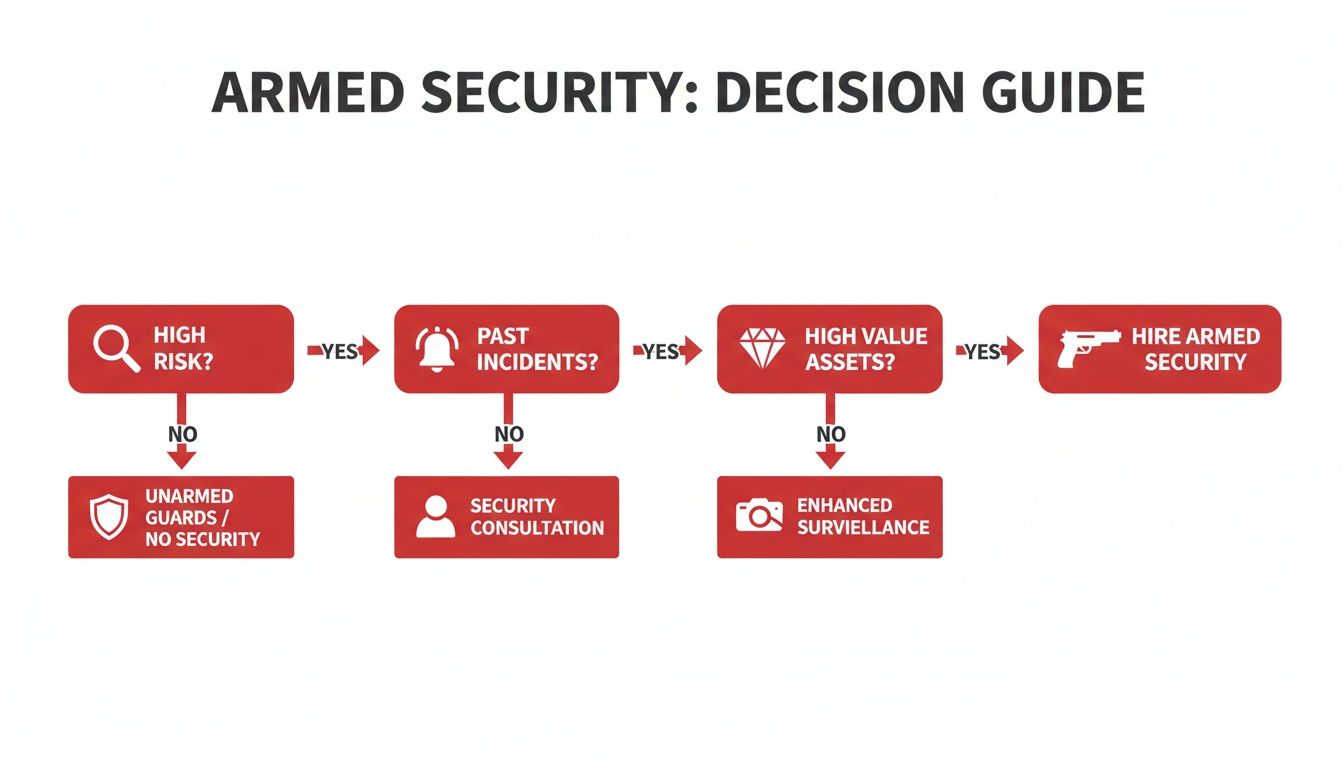
When high risk, past incidents, and valuable assets overlap, the argument for armed security becomes incredibly strong. By evaluating your own property against these criteria, you can confidently determine if this level of protection is the right fit.
To make it even clearer, here’s a breakdown of the most common indicators that justify bringing in armed professionals.
Key Indicators That Justify Armed Security
| Risk Factor | Description | Common Property Types Affected |
|---|---|---|
| High Cash Volume | Businesses that handle significant amounts of cash on-site, making them prime targets for robbery. | Banks, Credit Unions, Retail Stores, Cannabis Dispensaries, Cash-Intensive Businesses |
| Valuable Inventory | Locations storing high-value, easily transportable goods like jewelry, electronics, or pharmaceuticals. | Jewelry Stores, High-End Retail, Pharmacies, Warehouses, Tech Companies |
| History of Violent Crime | Properties with a documented history of violent incidents (robbery, assault) on-site or in the immediate vicinity. | Apartment Complexes, Shopping Malls, Parking Structures, Entertainment Venues |
| Threats Against Personnel | Specific, credible threats made against executives, employees, or other key personnel. | Corporate Headquarters, High-Profile Individual Residences, Government Facilities |
| Sensitive Data or IP | Facilities housing critical data centers, research labs, or proprietary information attractive to corporate espionage. | Data Centers, R&D Facilities, Tech Campuses, Defense Contractors |
| High Public Traffic | Locations with a large, constant flow of public traffic, which increases the probability of random incidents. | Hospitals, Transportation Hubs, Large Public Venues, University Campuses |
These factors are often interconnected; a property may have several of these indicators at play. Recognizing them is the first step toward building a security program that truly matches your risk profile.
The Real Role of an Armed Security Guard

The real value of an armed security guard is far more professional and subtle than often portrayed. Their most powerful tool isn't their firearm—it's their presence. A sharp, uniformed professional sends a clear signal that a property is protected, serving as one of the most effective deterrents to opportunistic crime.
The day-to-day work of an armed guard is focused on prevention and responsible protection. They are trained to de-escalate volatile situations long before law enforcement needs to get involved, requiring a calm, authoritative approach and a solid understanding of their legal authority.
Core Responsibilities in Action
Beyond being a visible deterrent, an armed officer's duties are strategic and tailored to the unique risks of your property. The security plan for a bustling retail center looks very different from one for a high-value construction site after dark.
Here’s what they are actually doing:
- Proactive Deterrence: Actively patrolling key areas to discourage threats like vandalism, theft, or trespassing before they start.
- Access Control: Managing who comes and goes from sensitive areas, verifying credentials, and ensuring only authorized individuals enter critical zones.
- Incident Response: Acting as the immediate first responder for alarms, disturbances, or medical emergencies, stabilizing the situation until police or paramedics arrive.
An armed guard's primary mission is to prevent an incident from ever happening. Their training is focused on observation, de-escalation, and decisive action only when absolutely necessary, making them a stabilizing force.
De-escalation and Threat Management
There is a common misconception that an armed officer's job is to be confrontational. The reality is the opposite. A significant portion of their training is dedicated to conflict resolution and verbal de-escalation. The goal is always to defuse a tense situation—whether it’s a disruptive person or a theft attempt—without resorting to physical force.
Defining exactly what you expect from your armed security guards is critical. This is where creating clear Standard Operating Procedures comes in. These written instructions ensure every officer knows their specific duties, your emergency protocols, and how to report incidents on your property.
For example, at a luxury retail store, the mere presence of an armed guard can make organized retail crime rings think twice. At a construction site, that same professional presence overnight protects millions of dollars in equipment from theft. Ultimately, the role is a blend of vigilance, customer service, and absolute preparedness.
Understanding California's Strict Training Standards
Hiring armed security guards in California means bringing in professionals who have cleared some of the highest legal and training hurdles in the country. The state's Bureau of Security and Investigative Services (BSIS) enforces a demanding, multi-step qualification process.
Understanding this process helps you ask the right questions to verify your security partner operates with the highest level of compliance and professionalism. The path to becoming an armed officer is designed to select only the most responsible and capable individuals.
Before an officer can consider carrying a firearm, they must secure a standard Guard Card. This involves a thorough background check with both the Department of Justice and the FBI to screen out anyone with a disqualifying criminal history. From there, the requirements become even more stringent.
The Exposed Firearm Permit: A Critical Credential
The single most important document for an armed officer is the Exposed Firearm Permit. Obtaining this permit is a serious undertaking, signaling that an officer has been vetted for their capacity to exercise sound judgment under extreme pressure.
To earn this permit, a candidate must complete a BSIS-certified firearms course, which includes:
- 14 Hours of Intensive Training: This covers the moral and legal responsibilities of using deadly force, alongside practical, hands-on range instruction and a live-fire qualification.
- Psychological Evaluation: A licensed psychologist must conduct a mandatory assessment to confirm the candidate is mentally and emotionally fit to carry a firearm. This is a critical screen for judgment and stability.
- Ongoing Proficiency: The permit isn't a one-time achievement. Armed officers must complete two range requalification shoots every six months to prove they remain safe and proficient.
This commitment to continuous training is what distinguishes a professional security force. For a more detailed breakdown, you can learn more about the complete security guard licensing process in California in our dedicated guide.
The Overton Security Commitment to Excellence
While California's requirements set a high bar, we view them as the starting point. At Overton Security, with 26 years of experience, we know that meeting state requirements alone doesn't create an exceptional officer. We invest significantly more in our team, building a culture of professionalism that goes far beyond checking boxes.
True security is built on rigorous state licensing, continuous company-backed training, and a professional culture that retains good people. An officer who feels valued and supported is sharper and better prepared to protect your property.
Our focus on retaining professional officers means the guards on your site are not just licensed—they are seasoned professionals who have built a career with us. By choosing a partner that invests in its people, you gain the peace of mind that comes from knowing your security is in capable, experienced hands.
Where Does Armed Security Actually Make a Difference?
It’s one thing to talk about armed security in theory, but it’s another to know exactly where it provides the greatest value. Deciding to bring in armed professionals is a strategic move for situations where the risk profile demands an immediate, decisive response.
The core question for any property manager is: does my property truly need this level of protection? While every location is different, certain environments consistently see a significant return on this investment.
This isn't just a hunch; the market reflects this growing reality. The global security guard industry was valued at around $220 billion in 2023 and is projected to reach $350 billion by 2032. This growth is driven by more high-risk properties recognizing professional protection as a fundamental operational need. If you're curious about the data behind this trend, you can discover more insights on the security market from DataIntelo.com.
High-Risk Retail and Financial Institutions
Nowhere is the need for an armed presence more obvious than in businesses that handle high-value, easily-moved assets like jewelry stores, cannabis dispensaries, banks, and credit unions. These locations are prime targets for armed robbers.
An armed officer is a powerful, visible deterrent. Their presence alone can disrupt a criminal's plan, providing a critical layer of reassurance for employees and customers while actively protecting the bottom line.
Securing High-Value Construction Sites
Construction sites are often sprawling, poorly lit after hours, and packed with thousands of dollars in tools, heavy equipment, and raw materials. Organized theft rings can hit a site overnight, causing massive financial losses and derailing project timelines.
Placing an armed guard on-site, especially for overnight and weekend shifts, changes the game. It sends a clear message that the site is protected. They can:
- Safeguard expensive machinery and materials.
- Prevent vandalism that can set a project back weeks.
- Ensure that only authorized personnel are on-site.
Restoring a Sense of Safety in Residential Communities
For an HOA board or residential property manager, resident safety is paramount. When a community is shaken by a serious incident like a home invasion or a spike in local crime, an armed patrol can be an effective tool for restoring peace of mind.
In these scenarios, an armed guard’s value is as much about psychological reassurance as it is about physical protection. A professional, visible patrol tells residents their safety is the top priority.
This proactive presence also broadcasts a clear warning to would-be criminals that this is no longer a soft target. By actively patrolling common areas and key entry points, armed guards don't just respond to incidents; they help prevent them from happening.
How Technology Amplifies On-Site Security

A single armed security guard is a powerful presence, but their effectiveness is amplified when backed by a solid technology ecosystem. The best security strategies today blend human expertise with smart technology.
This layered approach creates a security posture that is more responsive and accountable than either component could be on its own. It transforms an officer into the on-site tip of a much larger, more intelligent spear. For property managers, this blend delivers both real peace of mind and powerful operational insights.
The Security Operations Center as Mission Control
The backbone of this integrated strategy is the 24/7 Security Operations Center (SOC). Think of it as mission control for every officer in the field, providing real-time oversight, a direct line for support, and an immediate escalation point.
Instead of an officer working in a vacuum, they are constantly connected to a team of dispatchers and supervisors. This central hub offers key advantages:
- Real-Time Officer Support: If an officer needs backup or law enforcement, the SOC can dispatch the right resources immediately.
- Remote Monitoring: SOC operators can watch live camera feeds, verify alarms, and provide officers with critical intelligence before they approach a potential threat.
- Wellness Checks: Regular check-ins ensure officers are safe, which is especially critical during overnight shifts at remote locations.
The real power of a modern security program lies in the connection between on-site presence and remote oversight. This creates a proactive defense that stops incidents before they escalate.
GPS Guard Tours and Digital Reporting
Gone are the days of wondering if patrols were completed. Modern GPS-enabled guard tour systems provide clients with total transparency and accountability. This is how you know exactly what’s happening on your property.
Officers use handheld devices to scan checkpoints at key locations, creating a time-stamped, verifiable digital trail of every patrol. These systems allow them to create detailed digital reports—complete with photos and notes—that are delivered straight to you. This data is invaluable for spotting security trends and ensuring post orders are followed.
These detailed reports provide the proof of performance that builds trust. For a deeper dive, explore our resources on the integration of security systems.
Armed security guards are a major part of the global private security workforce, which includes over 25 million personnel worldwide. With North America holding 41% of the market share, the demand for accountable, tech-forward officers is higher than ever. To see more on these trends, you can find detailed market growth reports here. This is why blending human expertise with smart technology is a necessity for any premium security program.
Choosing the Right Armed Security Partner
Selecting a provider for armed security is one of the most important decisions a property manager can make. This isn't just about filling a spot on a schedule; it's a choice that directly impacts your liability, reputation, and the safety of everyone on your property.
This decision demands careful vetting. You're not looking for a vendor—you're looking for a true security partner who understands their officers are an extension of your brand and a reflection of your commitment to safety.
Look Beyond the Basics of Licensing
Every legitimate security company in California will have licensed officers. That’s the bare minimum. A truly professional partner goes much further. When vetting potential providers, it’s critical to dig deeper into the operational and cultural aspects that separate the best from the rest.
Start by asking pointed questions about their operational support and insurance coverage.
- Insurance Specific to Armed Services: General liability insurance is not enough. Ask to see their certificate of insurance and confirm they carry specific, robust coverage for armed officers.
- Employee Screening Process: Go beyond the standard background check. Ask about their screening for judgment and temperament, including any psychological evaluations.
- Field Supervision Structure: Find out how often supervisors visit the site. A company with a low manager-to-client ratio—a cornerstone of our philosophy at Overton Security—ensures your property gets the hands-on attention it needs.
The Critical Importance of Company Culture
In the security industry, high employee turnover is a major red flag. It’s a sign of a "burn and churn" model where officers are treated as disposable, leading to inconsistency and inexperience at your property.
An officer who is new to your site doesn’t know its vulnerabilities, its people, or its specific post orders. They are starting from scratch every single shift.
A provider’s officer retention rate is one of the strongest indicators of its service quality. A company that invests in its people cultivates experienced, reliable officers who are committed to their roles.
A stable, professional team means you get guards who are seasoned experts and understand the immense responsibility they carry. This is the difference between simply having coverage and having a genuine security solution.
Contrasting Security Partner Models
When you evaluate providers, you will notice two very different business philosophies. Understanding this distinction is key to making the right long-term choice.
| The 'Quality Over Quantity' Partner | The 'Burn and Churn' Vendor |
|---|---|
| Focuses on officer retention and career development. | Experiences high turnover, leading to new faces on-site. |
| Maintains a low manager-to-client ratio for hands-on service. | Overloads managers, resulting in less client attention. |
| Invests in continuous, advanced training beyond state minimums. | Often provides only the legally required training. |
| Builds long-term relationships based on trust and results. | Competes primarily on the lowest possible price. |
The demand for armed security guards is growing. The event security market alone is projected to grow from $5.52 billion in 2025 to $7.11 billion by 2029. This growth makes it even more important to select a partner who can provide consistent, high-quality service. To understand more about this trend, you can read about the latest security guard industry statistics from BelfrySoftware.com.
Ultimately, choosing the right partner is about finding a company whose values align with your own. For a deeper look at what to look for, check out our guide on how to select the right private security company.
Answering Your Questions About Armed Security
Deciding to bring in armed security guards naturally comes with practical questions about cost, authority, and operations. Getting clear, straightforward answers is the only way to build a security plan you can trust.
Let's tackle some of the most common questions we hear from property managers and business owners.
What Is the Cost Difference Between Armed and Unarmed Guards?
Armed guards have a higher bill rate, and for good reason. The increased cost directly reflects the significant investment in training, licensing, and insuring an armed officer.
This premium covers rigorous firearms certifications, continuous qualification training, and the much higher liability insurance policies a security provider must carry. While the upfront cost is higher, you are paying for an elevated level of deterrence and response that is critical for high-risk properties.
How Does an Armed Guard's Authority Differ from a Police Officer's?
This is a crucial distinction. An armed security guard is a private citizen and does not have the legal powers of a sworn law enforcement officer. Their role is focused on deterring threats and protecting people and assets on a specific, designated property.
While they can perform a citizen's arrest, their authority to use force is strictly governed by state laws around self-defense and the defense of others. Our guards receive extensive training on the Use of Force Continuum to ensure any action taken is lawful, justified, and proportional to the threat.
The core difference is jurisdiction. A police officer serves the public and enforces public law. An armed guard serves a specific client to protect their private property within the bounds of civil law.
What Kind of Reporting Should I Expect?
A simple handwritten log no longer meets professional standards. Detailed, transparent reporting is non-negotiable. The standard for any modern security partner is a GPS-enabled Guard Tour Management System, or GTMS.
This technology allows officers to file digital Daily Activity Reports (DARs) and incident reports in real-time from the field. These reports are time-stamped, can include photos, and should be instantly accessible to you. This system creates total accountability and gives you a clear, verifiable record of all security activity on your property.
Can I Request a Security Plan Before Signing a Contract?
Yes, and you absolutely should. A reputable security partner will never push a generic solution. The process should always start with a thorough site assessment to understand your property's unique vulnerabilities and operational flow.
This is a collaborative process. We walk the property with you, identify critical risk areas, and discuss your specific goals. This is how we build a security plan that is truly tailored to your needs, creating a strong foundation for an effective partnership.
At Overton Security, we believe a successful security program is built on transparency, trust, and a deep understanding of your needs. With over 26 years of experience, we provide tailored armed security solutions backed by smart technology and hands-on leadership. If you’re ready to discuss a security plan that truly protects your property, contact us today.