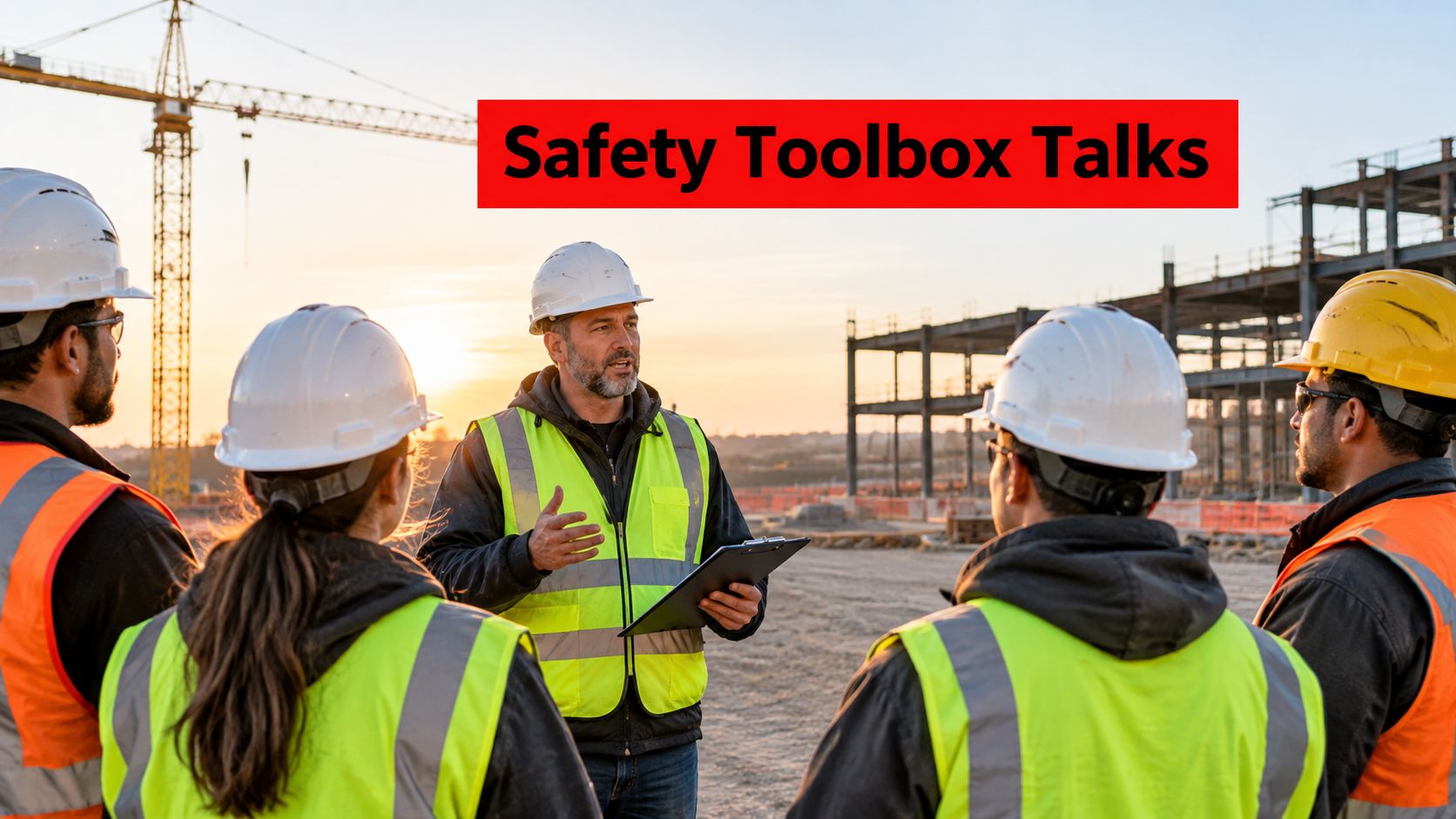
A busy site is already moving before the first lift starts. A new subcontractor is checking in, deliveries are approaching the gate, and several crews are preparing different tasks at once. The supervisor has about ten minutes to explain the day's risks before production begins.
The strongest toolbox talks use that time well. They're brief, hazard-specific, and interactive, not generic lectures. A CDC/NIOSH-supported study found that 25% of surveyed workers reported that their crews never conducted safety meetings, while visual formats helped workers identify hazards from more than 1.5 meters farther away when line drawings were used instead of photographs. The same research found that a redesigned toolbox-talk format was preferred by 82% of supervisors and reduced preparation and presentation time by 15 minutes. CDC/NIOSH research on toolbox talks
The ten construction site safety meeting topics below are ordered from foundational PPE expectations to incident reporting. Each can stand alone as a short briefing or fit into a weekly rotation. Keep the discussion tied to the work planned, ask workers what they see, and finish with one clear action.
1. Personal Protective Equipment Compliance and Inspection
PPE expectations should be clear before anyone crosses from the gate into the work area. Start by naming the required equipment for the day's tasks and zones, including hard hats, safety glasses, gloves, steel-toed boots, high-visibility vests, respirators, and fall protection equipment where applicable.
The supervisor should hold up examples of acceptable and damaged equipment. Workers need to know how to check for cracks, worn straps, missing parts, contamination, poor fit, and expired or otherwise unsuitable protection. PPE reduces exposure when hazards can't be fully eliminated, but only when workers select, wear, and maintain it correctly.
Make compliance visible
Post a visual checklist at each entry point. Show the PPE required for common zones, such as demolition areas, vehicle routes, hot-work locations, and work-at-height zones. A rotating safety champion can inspect equipment during the morning briefing and document findings without turning the meeting into a lecture.
A site safety manager also needs a process for follow-up, not just reminders. Use the site safety manager responsibilities as a reference point for assigning ownership, documenting deficiencies, and confirming that corrections are completed.
Practical rule: A worker who lacks the required PPE doesn't start the task until the supervisor resolves the gap.
For Overton Security officers, PPE checks can reinforce the site's formal program during patrols. Officers can report workers entering controlled areas without required protection, photograph visible non-compliance when authorized, and send time-stamped observations to the site superintendent. The patrol supports accountability, but the employer remains responsible for training, selection, and enforcement.
2. Fall Protection and Working at Heights
Before roof work, scaffold access, leading-edge activity, or work at height, ask one direct question: where can someone fall today? Walk through the answer with the crew. Point out roof edges, floor openings, ladders, scaffolds, platforms, and areas where workers may move between protected and unprotected surfaces.
OSHA construction standards generally require fall protection when a worker is exposed to a fall of 6 feet or more above a lower level. Falls caused 37% of construction deaths in 2021, according to Texas Department of Insurance guidance summarizing OSHA fatality data. The talk should therefore focus on the exact system used at each location, not just on wearing a harness.
Verify the system before work
The competent person should confirm that guardrails, safety nets, personal fall-arrest systems, warning lines, and anchor points match the task. Workers must inspect harnesses, lanyards, connectors, and anchor connections before use. Explain how they'll stay protected while climbing, repositioning, transferring, or working near an opening.
A rescue plan belongs in the briefing. Identify who calls for help, who controls the area below, and how the site will respond if a worker is suspended after a fall. Security officers should know the high work zones and report unprotected workers, damaged barriers, or unauthorized access during patrols. They can help preserve the exclusion area while the site team corrects the condition.
The talk should finish with a named supervisor responsible for verifying protection before the crew starts. A photograph of the setup may support quality assurance, but it doesn't replace inspection by a qualified or competent person.
3. Hazard Communication and Chemical Safety
A new container on site can change the risk picture immediately. Before workers handle solvents, adhesives, paints, epoxies, asbestos, lead, or other hazardous substances, identify what's present, where it's stored, and how workers will respond to contact, inhalation, fire, or a spill.
Use the Globally Harmonized System, or GHS, to explain labels and pictograms in plain language. Show workers where the Safety Data Sheets, or SDS, are kept. The information must be accessible when people need it, including during off-hours and emergencies.
Connect labels to decisions
Ask workers to find the SDS for one material used that day. Have them identify the required PPE, storage precautions, first-aid information, and spill response steps. This small exercise is more useful than telling the crew to “read the SDS” without showing them how.
Maintain a master chemical inventory with location tags. Store chemicals in compatible containers, keep labels intact, and remove unknown or unlabelled containers from use until the responsible person identifies them. A waterproof binder and a digital copy can provide access when conditions are wet or the main office is closed.
Security patrols can reinforce storage controls. Officers should check chemical areas for unauthorized access, damaged or missing labels, unsecured containers, and storage conditions that appear inconsistent with site procedures. They shouldn't handle chemicals or make technical determinations. Their role is to identify, document, and escalate.
A commercial renovation site, for example, may have paint thinners stored near a delivery route. The useful meeting action is specific: relocate the material, confirm the approved storage area, and assign someone to verify the change before work continues.
4. Struck-By and Caught-Between Hazards Prevention
A worker can be exposed to several moving hazards before the first scheduled break. Delivery trucks may cross a pedestrian route, a crane may swing over a work area, and a loader may reverse near a blind corner. Treat these as coordination problems, not merely individual awareness issues.
OSHA's Focus Four categories include falls, struck-by incidents, caught-in or caught-between hazards, and electrocutions. Together, they represent nearly 60% of construction fatalities each year, while falls from elevation alone account for nearly 40% of construction deaths, according to CDC/NIOSH construction safety information. This talk should target the exposures present on that shift.
Mark the hot zones
Show the crew the exclusion zones for overhead work, suspended loads, mobile equipment, demolition, and deliveries. Explain who controls entry and which signals operators and spotters will use. Spotters need high-visibility clothing, a clear position, and agreed hand signals. Workers must know that eye contact with an operator doesn't authorize them to enter a swing radius or travel path.
Use durable, legible signs at entrances and route changes. Clear construction safety signage helps reinforce the boundaries discussed in the meeting, especially when crews change during the day.
Overton Security officers can patrol exclusion zones, monitor gates, and report unauthorized entry. They should understand the site hazard map and escalation path. If site policy authorizes officers to stop work, the procedure must be explicit, including who receives the immediate call and who verifies that the zone is safe before restarting.
End with one site-specific assignment. It might be moving a barricade, adding a spotter to a delivery route, or updating the map after a crane location changes.
5. Scaffold Safety and Competent Erector Requirements
Scaffold safety depends on how the structure was designed, erected, inspected, loaded, and changed. A platform can look stable while a loose connection, damaged deck, leaning upright, missing guardrail, or unauthorized modification creates a serious exposure.
The meeting leader should identify the scaffold areas in use that day and confirm who performed the inspection. OSHA requirements place design responsibility with a qualified person and erection responsibility with a competent erector. Workers should understand that they can't alter a scaffold, remove a component, or use an incomplete structure without authorization.
Make the inspection decision clear
A pre-use inspection and sign-off should occur before work starts. Post load-capacity limits where workers can see them, and keep materials distributed rather than concentrated on one platform. The perimeter walk should include decking, braces, base conditions, access, guardrails, toe boards, ties, and signs of impact or movement.
Ask the crew what would make them stop using the scaffold. The answer should include damaged decking, missing components, instability, unexpected movement, and any condition the authorized inspector hasn't evaluated.
Security officers can observe scaffolds during patrols without climbing or conducting the formal inspection. If an officer sees damaged decking, an altered guardrail, unsecured materials, or workers using a scaffold that appears closed, the officer should preserve the observation, restrict access only within assigned authority, and notify site management.
This division matters. Security can provide an additional set of eyes and protect the area. The competent person remains responsible for the scaffold inspection and release decision.
6. Electrical Safety and Arc Flash Prevention
Electrical briefings should distinguish between workers who perform electrical tasks and workers who work near electrical systems. Only qualified electricians should perform electrical work, but every person on site needs to recognize damaged cords, exposed conductors, open panels, overhead lines, temporary power hazards, and unauthorized access.
The practical sequence is simple: identify the source, isolate it when required, verify the condition, and control access. Lockout/tagout procedures apply when equipment must be de-energized for servicing or maintenance. Discuss who applies locks and tags, who verifies isolation, and who may remove them.
Tie the talk to the day's work
Before temporary power setup, inspect cords, receptacles, distribution panels, and GFCI protection. Before electrical maintenance, review the energy-control procedure and required arc-flash PPE. Before work near overhead lines, identify the route, equipment limits, and communication method.
Post warnings at electrical rooms and panels. Keep the temporary power distribution map current. The meeting should also identify the emergency response steps, including how to summon help without approaching an energized victim or creating a second casualty.
Overton Security can support access control around electrical rooms and panels. Officers should know which areas are restricted, verify authorized access where that is part of the post order, and report open panels, damaged barriers, or suspicious activity. They don't replace the electrician, the qualified person, or the site's energy-control program.
A useful close is a short walk to the nearest temporary panel. Have the supervisor point out the GFCI, the emergency contact method, and the boundary that unqualified workers must not cross.
7. Excavation Safety, Trenching, and Soil Competency
Excavation work changes quickly. Rain, water, vibration, nearby equipment, stored materials, and changing geometry can affect soil and stability. A competent person must evaluate the excavation before entry and whenever conditions change.
Two depth rules need to stay separate. OSHA requires a protective system for employees entering an excavation 5 feet or deeper, unless the excavation is entirely in stable rock. Separately, trenches 4 feet deep or more must provide a ladder, stairway, ramp, or another safe means of egress, as explained in OSHA trenching and excavation guidance. A trench can therefore require a ladder before cave-in protection becomes mandatory.
Confirm the controls at the edge
Before breaking ground, confirm utility locating and the approved excavation plan. Review soil classification, sloping, benching, shoring, or shielding. Keep spoil piles, vehicles, and materials away from the edge according to the site's engineered and regulatory requirements. Discuss atmospheric testing where the excavation is deep, enclosed, or potentially contaminated.
No worker enters without authorization from the competent person. Identify the rescue plan, access point, emergency communication method, and location of rescue equipment. Don't let a well-intended coworker enter for an improvised rescue.
Security officers can protect the perimeter, monitor gates, and report unauthorized entry or missing barriers. They should know where the excavation is, which access points are approved, and whom to contact when conditions change. The code requirements for excavation can provide additional context, but the project's competent person and applicable OSHA requirements control site decisions.
8. Housekeeping, Fire Prevention, and Site Order
Housekeeping is a production control as well as a safety control. Debris, loose tools, blocked walkways, spills, and poorly stored materials make it harder to see hazards and harder for workers or emergency responders to move through the site.
Assign responsibility at the start of the shift and repeat the check at the end. Ask the crew to identify the location for scrap, flammable liquids, tools, waste, and materials awaiting installation. Walk the actual route workers will use, rather than discussing housekeeping from the trailer.
Cover ordinary clutter and hot work
For hot work, confirm the permit, remove combustible materials, place the fire watch, and verify that suitable extinguishers are accessible. The fire watch should remain in position for 30 minutes after work ends, as specified in the site's planned control. Keep exits, fire equipment, and emergency access routes clear.
A simple end-of-shift routine can include:
- Remove debris: Clear scrap, packaging, sharp materials, and loose waste.
- Restore walkways: Keep pedestrian routes visible, stable, and free of cords or stored materials.
- Secure liquids: Place paints, fuels, solvents, and other liquids in approved storage with appropriate containment.
- Record the condition: Note unresolved hazards and assign an owner before the crew leaves.
The construction site safety checklist can help supervisors standardize the walk and document follow-up. Overton Security officers can reinforce the process during patrols by reporting accumulating debris, blocked access, unsecured materials, and visible fire hazards. Digital reports with photographs and timestamps help management act on the observation instead of relying on memory.
9. Heat Stress, Cold Exposure, and Environmental Hazard Management
Weather belongs in the daily risk picture. A crew that worked safely in mild conditions may need a different plan when temperatures rise, wind increases, surfaces ice over, or a storm approaches. The supervisor should state the expected conditions, the work adjustments, and the person authorized to change the plan.
For heat, identify water, shade, rest locations, buddy checks, and the route for reporting symptoms. OSHA partnership materials reference the OSHA Heat Safety Tool and National Weather Service information as resources for planning. Workers should report confusion, unusual quietness, difficulty concentrating, weakness, or other concerning symptoms early.
Turn awareness into decisions
The meeting should answer four questions:
- Who checks conditions: Name the supervisor or designee who reviews weather information.
- When work changes: State when crews move to shade, take additional recovery time, change sequence, or stop.
- How new workers are supported: Pair new or temporary workers with experienced workers and monitor their adjustment.
- Who receives a concern: Provide a confidential route for reporting symptoms, fatigue, impairment, harassment, or security concerns.
Cold-weather talks should address layered clothing, warming areas, hand protection, wet conditions, reduced dexterity, and slippery surfaces. Lone workers and after-hours crews also need a check-in procedure, emergency-access plan, and clear coordination between supervisors, dispatchers, guards, and responders.
Overton Security officers can conduct wellness observations during patrols when the post order calls for it. They should report concerns immediately, avoid diagnosing medical conditions, and know how to summon the supervisor or emergency services. Worker participation matters more than a polished presentation. People must see that reported conditions lead to action.
10. Incident Reporting, Investigation, and Corrective Action
A near miss deserves a clear response even when nobody is injured. It shows where a control failed, where a worker had to improvise, or where conditions changed faster than the plan. Treating the report as useful information encourages people to speak before the next event produces harm.
Start the meeting by explaining who reports, who receives the report, and what happens afterward. Use one simple form for injuries, near misses, property damage, and significant hazards. The form should capture the location, task, conditions, witnesses, immediate controls, and follow-up owner.
Preserve facts and close actions
For a serious event, secure the scene and protect evidence. Take photographs and video when authorized, identify witnesses, and avoid moving equipment or materials unless necessary to protect people. Interview witnesses separately while their recollections are fresh. The investigator should look beyond the worker's action and examine planning, supervision, equipment, communication, and environmental conditions.
A strong corrective action has an owner, a due date, and a verification method. “Retrain the crew” may be appropriate, but it shouldn't be the only response if the actual issue is a missing barrier, unclear route, poor equipment design, or conflicting work sequence. Share the finding with the workforce so reporting leads to visible improvement.
Overton Security officers may be first on scene. Their post orders should explain how to call for help, protect access, document observations, identify witnesses, and preserve the area. They shouldn't speculate about cause or assign blame. The construction site safety orientation can support consistent communication for new workers, subcontractors, and officers.
End the talk with one closure question: what action from the last report is still open? If nobody can answer, the reporting system may be recording events without managing them.
10-Point Construction Site Safety Topics Comparison
| Title | Implementation complexity | Resource requirements | Expected outcomes | Ideal use cases | Key advantages |
|---|---|---|---|---|---|
| Personal Protective Equipment (PPE) Compliance and Inspection | Low–Medium: training, audits, and zone assignments | Moderate: PPE inventory, replacement budget, inspection time | Higher PPE adoption, fewer minor injuries, OSHA compliance | All sites; entry points and high-risk zones | Visible safety culture; reduces claims; easy visual enforcement by security |
| Fall Protection and Working at Heights | High: site-specific plans, competent persons, rescue procedures | High: harnesses, anchors, training, inspection/certification | Reduction in fatal falls; improved regulatory compliance | Work >6 ft, roofing, scaffolding, elevated platforms | Prevents fatal incidents; lowers liability; insurer benefits |
| Hazard Communication and Chemical Safety (GHS/SDS) | Medium: inventory, labeling, SDS access systems | Moderate: SDS management, labels, spill kits, training | Fewer chemical incidents; faster emergency response; HCS compliance | Sites using solvents, paints, adhesives, hazardous materials | Protects against acute/long-term exposure; standardized labeling |
| Struck‑By and Caught‑Between Hazards Prevention | Medium–High: exclusion zones, spotter programs, traffic controls | Moderate: barriers, spotters, alarms, training | Reduced struck‑by/caught‑between incidents; protected work zones | Sites with cranes, heavy equipment, overhead work | Prevents severe injuries; proactive zone enforcement by security |
| Scaffold Safety and Competent Erector Requirements | High: design, competent erector, frequent inspections | High: scaffold systems, certified erectors, inspection documentation | Safer repeated access at height; fewer collapses and falls | Extended elevated work requiring platforms | Reliable, reusable access; reduces scaffold-related fall risk |
| Electrical Safety and Arc Flash Prevention | High: LOTO programs, arc‑flash analysis, access controls | High: arc‑flash PPE, GFCIs, qualified electricians, testing | Reduced electrocutions and arc‑flash incidents; equipment protection | Temporary power, energized work, complex electrical installs | Prevents severe electrical injuries; enforces qualified-work rules |
| Excavation Safety, Trenching, and Soil Competency | High: soil classification, protective system design, competent person | High: shoring/sloping systems, utility locating, rescue gear | Prevention of cave‑ins and utility strikes; regulatory compliance | Trenching, deep excavations, utility work | Prevents fatal cave‑ins; protects buried infrastructure |
| Housekeeping, Fire Prevention, and Site Order | Low–Medium: daily routines, 5S inspections, hot work controls | Moderate: labor, waste disposal, fire extinguishers, signage | Fewer trips/fires, improved site order and emergency access | All sites; hot‑work areas; high debris projects | Reduces fire/trip hazards; improves site professionalism |
| Heat Stress, Cold Exposure, and Environmental Hazard Management | Medium: monitoring, acclimatization plans, break schedules | Low–Moderate: shade, water, clothing, monitoring tools, training | Fewer heat/cold illnesses; maintained productivity and morale | Extreme climates, prolonged outdoor work, seasonal shifts | Protects worker health; prevents fatal environmental illnesses |
| Incident Reporting, Investigation, and Corrective Action | Medium: reporting protocols, investigation training, root‑cause analysis | Low–Moderate: forms/digital systems, trained investigators, time | Faster corrective actions, reduced recurrence, documented compliance | All sites; post‑incident improvement and near‑miss programs | Enables corrective action, preserves evidence, supports continuous improvement |
Turn Your Next Briefing Into a Safer Shift
A useful safety meeting doesn't need to cover every hazard on the project. It needs to address the hazard that workers are most likely to face during the next task, explain the control in practical terms, invite questions, and confirm who will verify the control. The CDC/NIOSH model supports this structure by combining a concise hazard explanation, a real-life incident narrative, discussion questions, and a recap of prevention actions. NIOSH construction toolbox talks are designed for supervisors, foremen, safety trainers, and business owners who need to connect the conversation to current work.
The historical case for short, repeated meetings is strong. In 2015, construction accounted for 19% of all U.S. work-related deaths, the largest share of any industry at that time, according to ASSP's discussion of toolbox safety training. That same discussion describes a study across nine companies and 16 work sites, where 351 workers received one toolbox talk per week for eight consecutive weeks. Talks with narrative content and discussion questions produced greater overall knowledge gains than talks without those elements.
Use that evidence carefully. A toolbox talk supplements formal training, written procedures, competent-person supervision, and emergency planning. It doesn't replace any of them. A short meeting is effective because it reinforces the system at the moment workers need to use it.
For the coming week, choose one topic and run it as a focused five-minute talk. Log one site-specific action, such as a PPE check, a zone-map update, an excavation access review, a hot-work inspection, or a near-miss discussion. Ask one worker to describe the control in their own words, then verify that the control is visible in the work area.
A weekly rotation builds habits faster than occasional long sessions. Keep attendance records, topic notes, worker questions, assigned owners, and closure evidence together. For additional planning support, review these four OSHA compliance tips, then adapt the meeting to your site, crew, and current work plan.
Overton Security can reinforce that plan with stationed officers, vehicle patrols, access control, fire watch, and construction site security across California, including Los Angeles, San Francisco, San Diego, Sacramento, San Jose, Oakland, Long Beach, and Fresno. With 26 years of experience, a low manager-to-client ratio, hands-on leadership, GPS-enabled guard tours, digital daily activity reports, and 24/7 SOC oversight, Overton helps supervisors see what happens between meetings. Contact the team through overtonsecurity.com to discuss how patrols and digital reporting can support your construction site safety program.
Overton Security provides professional construction site security, stationed officers, vehicle patrols, fire watch, access control, and digital incident reporting backed by 24/7 SOC oversight. Connect your safety meetings to visible patrol checks, documented conditions, and clear escalation paths by visiting Overton Security to discuss a site-specific program.