
It often starts small. A missing tool here, a few dollars short in the cash drawer there, or a padded expense report. You might brush it off at first, but these small incidents can be the first signs of a much larger problem—one that's quietly draining your business from the inside out.
Addressing this issue isn't about creating a culture of mistrust. It's about acknowledging a genuine business risk that every property manager, construction superintendent, and business owner faces, and taking calm, professional steps to protect your assets and your team.
The Hidden Costs of Internal Theft
When we talk about employee theft, it’s not just about cash vanishing from the register. The problem runs much deeper, covering everything from stolen inventory and tools to valuable intellectual property and even company time. The financial impact can be significant, often adding up silently until it affects your bottom line.
Tackling this issue is about safeguarding your assets and, just as importantly, protecting the honest majority of your team. This guide will walk you through practical, real-world strategies that shift your approach from reacting to losses to proactively building a secure and trustworthy operation. The goal is simple: set clear expectations, establish responsible oversight, and ensure everyone understands their role in keeping the business healthy.
Moving From Reactive to Proactive
Taking a proactive stance on internal security is always more cost-effective than trying to recover losses after the fact. It’s about creating systems that make theft harder to commit and easier to detect, which naturally discourages anyone from even trying.
A solid, comprehensive strategy is built on a few key areas:
- Clear Policies: You need well-defined, easy-to-understand rules for everything from handling cash to using company assets and accessing sensitive data.
- Internal Controls: This means implementing smart checks and balances, like separating financial duties so one person isn’t handling everything, and conducting regular, unannounced audits.
- A Positive Culture: When team members feel valued and respected, they are far less likely to act against the company's best interests. A positive environment is a powerful deterrent.
- Professional Oversight: Sometimes, an expert eye is needed. Partnering with a security professional can introduce effective deterrents like visible patrols or smart access control monitoring.
By focusing on these pillars, you build a resilient framework for your operations. This is where an experienced security partner like Overton Security can make a significant difference. With our 26-year history of consistent, reliable service, we help you regain control by blending human expertise with smart technology. Our hands-on leadership and low manager-to-client ratio ensure you get the accountability and peace of mind you need.
Understanding the True Scope of Employee Theft
When you think about employee theft, what comes to mind? For most business owners and property managers, it’s the obvious: an employee pocketing cash from the register or walking out with merchandise. While those are serious problems, they’re just the tip of the iceberg.
The reality is that internal theft is a much broader and more complex issue, often growing into a major financial drain right under your nose. It’s a challenge that cuts across every industry.
Consider the retail sector. In 2023, retailers lost a staggering $112.1 billion in inventory. Of that, theft by employees was responsible for nearly 29%, which works out to about $32.5 billion in direct losses. What’s truly concerning is that these costs are climbing by roughly 15% annually. This isn't a minor issue; it's an escalating threat. You can explore more about these employee theft statistics to get the full picture.
Beyond Cash and Inventory
To fully grasp the impact, you have to look past the most visible forms of theft. Some of the most damaging types are the ones you can’t easily see—the quiet, intangible losses that steadily chip away at your profitability.
These hidden forms of theft include:
- Time Theft: One of the most common forms, this occurs when an employee is paid for work they didn’t do. Examples include extended breaks, "buddy-punching" for a late coworker, or habitually arriving late and leaving early.
- Data and Intellectual Property Theft: In today's digital world, your data is one of your most valuable assets. An employee could walk away with client lists, trade secrets, or sensitive financial information for personal gain or for a competitor.
- Payroll Fraud: This directly impacts your finances. It can be as sneaky as creating "ghost" employees and collecting their paychecks or as simple as falsifying timesheets to accumulate unearned overtime.
- Misuse of Company Resources: This may seem small, but it adds up quickly. Using company vehicles for personal errands, taking office supplies for home use, or abusing employee discounts are all forms of theft.
This infographic breaks down some of the main ways theft hurts a business, from the direct financial hit to the wasted time and disappearing inventory.
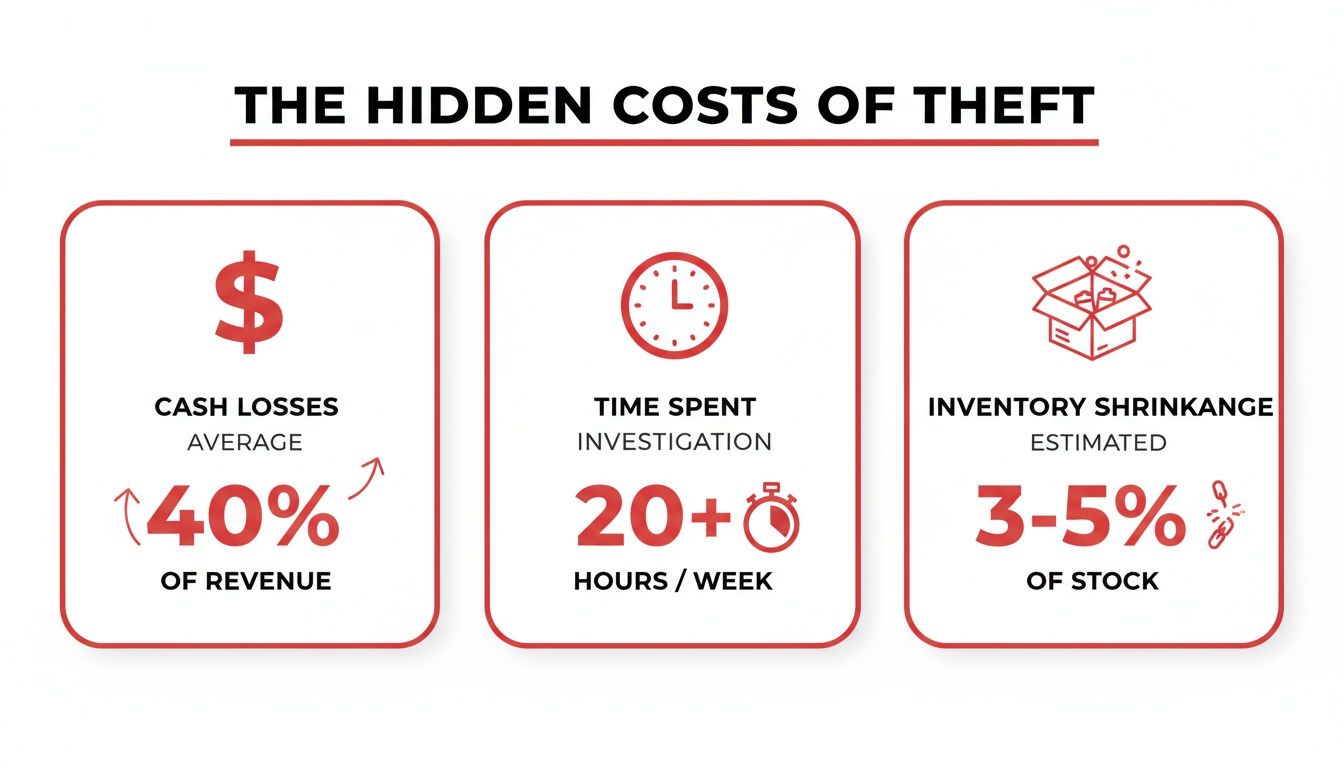
As you can see, the damage isn’t just the value of the stolen item. It’s also the time and resources you must spend investigating the incident and replacing what was lost.
How Different Industries Face Unique Risks
Not all businesses face the same threats. The security vulnerabilities on a construction site are entirely different from those in a corporate office or a high-end apartment building. A construction superintendent is concerned about tools and materials walking off the job, while a residential property manager might be more focused on data security or an employee misusing access privileges.
Recognizing these industry-specific risks is the first critical step toward building a defense that actually works for your business.
The real challenge for managers is recognizing that a one-size-fits-all security approach doesn't work. Your prevention strategy must be aligned with the unique operational realities and high-risk areas of your specific industry.
To help you pinpoint your vulnerabilities, the table below outlines some of the most common types of employee theft across different business sectors.
Common Types of Employee Theft by Business Sector
This table illustrates the most prevalent forms of internal theft across different industries, helping managers identify key risk areas specific to their operations.
| Business Sector | Primary Theft Type | Common Examples |
|---|---|---|
| Retail & Shopping Centers | Merchandise & Cash Theft | Shoplifting products, skimming cash from registers, fraudulent returns, or abusing employee discounts for resale. |
| Construction Sites | Equipment & Materials Theft | Stealing high-value tools, raw materials like copper wire or lumber, or siphoning fuel from company vehicles. |
| Corporate Offices | Data & Time Theft | Copying confidential client lists, falsifying expense reports, or misrepresenting hours worked on timesheets. |
| Residential Properties (HOAs) | Misuse of Assets & Service Theft | Unauthorized use of community amenities, fraudulent vendor invoicing, or theft of maintenance supplies. |
| Warehouses & Logistics | Inventory Shrinkage | Stealing products directly from inventory, collaborating with drivers to fake deliveries, or damaging goods to take them home. |
By identifying these key risk areas, you can start to focus your security efforts where they'll have the biggest impact. This targeted approach is how you protect your most valuable assets without harming the positive, productive culture you’ve worked so hard to build.
How to Recognize the Warning Signs of Internal Theft

Detecting internal theft early is about being observant. To get ahead of it, you need to shift from a reactive mindset to a proactive one. That starts with knowing what to look for, because theft by employees almost always leaves a trail of subtle clues long before it becomes a major loss.
These warning signs typically fall into two categories: behavioral flags tied to an individual and operational flags you can spot within your business processes. Recognizing these indicators is your first line of defense in protecting your assets.
Behavioral Red Flags
Sometimes, the earliest warnings come from changes in an employee's attitude, lifestyle, or daily habits. While these behaviors are not proof of wrongdoing on their own, a consistent pattern should prompt a closer—but discreet—look.
It's important to handle this with care, as personal struggles can also cause someone's behavior to change. Still, ignoring persistent red flags is a risk your business cannot afford.
Keep an eye out for these common behavioral indicators:
- Sudden Lifestyle Changes: Is an employee suddenly driving a luxury car, taking lavish vacations, or wearing designer clothes that don't match their known income? This is a classic warning sign.
- Defensiveness or Secrecy: An individual might become fiercely protective of their workspace, resist supervision, or refuse to share job duties. Often, this is because they are afraid of being discovered.
- Refusal to Take Vacation: Employees involved in ongoing fraud schemes frequently avoid taking time off. They may worry that a substitute will uncover their activities.
- Unusually Close Vendor Relationships: Good vendor relationships are an asset, but one that seems overly friendly or involves frequent personal gifts could be a sign of a kickback scheme.
Recent fraud analysis confirms how critical these behavioral cues are. One study found that 87% of perpetrators had no prior criminal record, meaning background checks alone are not enough. The single biggest indicator was an employee living beyond their means (39%), followed by financial difficulties (25%) and an unusually close association with a vendor (20%). These findings highlight why simple observation is such a powerful tool.
Operational Red Flags
Beyond an individual's behavior, the most solid evidence of internal theft often appears in your day-to-day operations. These are the tangible discrepancies—anomalies that pop up in your paperwork, inventory counts, and system logs.
When you have regular checks and balances in place, these irregularities become much easier to spot. Once you know what "normal" looks like, any deviation stands out. For property managers and business owners, paying attention to these details is essential for reducing losses. You can find more strategies in our guide on how to reduce shrinkage.
A well-run operation has a predictable rhythm. When that rhythm is consistently disrupted—through missing inventory, flawed paperwork, or odd transactions—it’s a clear signal that something needs a closer look.
Be on the lookout for these common operational signs:
- Inventory Shrinkage: This is the most obvious one. If your physical counts are consistently lower than your records with no clear explanation, theft is a likely culprit.
- Anomalies in Financial Records: Pay attention to a high number of voids, refunds, or "no-sale" transactions, especially if they're all coming from the same employee. This can be a simple way to pocket cash.
- Missing or Altered Documents: Invoices, purchase orders, or receipts that mysteriously vanish or appear to have been tampered with are often signs of someone trying to cover their tracks.
- Duplicate Payments: A dishonest employee might create a fake invoice for a real vendor and have the second payment routed to their own account.
- Unusual Access Patterns: Note any employees who consistently work late or come in on weekends for no clear reason. Also, watch for anyone accessing parts of the property or network that fall outside their normal job duties. Modern security tools like real-time monitoring solutions can alert you to this kind of suspicious activity as it happens.
By training your managers to spot both behavioral and operational signs, you empower them to become your first line of defense. This vigilance, combined with strong internal controls, creates a culture of accountability where honest employees thrive and potential issues are deterred.
Building Your Proactive Prevention Toolkit
Simply reacting to theft by employees after the fact is a losing strategy. An effective approach is proactive, built on a foundation of clear policies and solid controls. This isn’t about fostering an environment of suspicion; it’s about creating a professional workplace where accountability is a normal part of the daily routine.
A strong prevention toolkit blends procedural rules, smart technology, and people-focused strategies. Each layer reinforces the others, systematically closing security gaps, removing temptation, and sending a clear message: theft will not be tolerated or go unnoticed. When you implement this kind of layered defense, security becomes a strategic asset that stabilizes your operations.
Establishing Clear Anti-Theft Policies
Your first line of defense is a straightforward, comprehensive anti-theft policy. This document is the bedrock of your strategy, defining acceptable behavior and spelling out the consequences for breaking the rules. It should be a core part of your employee handbook, reviewed and signed by every new hire during onboarding.
A well-written policy leaves no room for interpretation. It must explicitly define what constitutes theft—covering physical assets like inventory and cash, as well as intangible ones like company time and confidential data. This ensures everyone is on the same page from day one.
The policy should also detail exactly how to report suspected theft, letting honest employees know who to approach and making them feel safe to do so. By making the rules clear, you establish a baseline of accountability. For a deeper dive, you can explore our comprehensive loss prevention strategies.
Implementing Robust Internal Controls
Internal controls are where your policy is put into action. They are the specific procedures and checks you weave into your operations to make theft harder to commit and easier to spot. Think of them as the practical guardrails that protect your company, especially in high-risk areas like finance, inventory, and cash handling.
Effective controls almost always involve the separation of duties, ensuring no single employee has end-to-end control over a sensitive financial process.
Some of the most effective internal controls include:
- Separation of Duties: Ensure the person who authorizes payments is not the same person who processes them. This one step can prevent numerous fraudulent schemes.
- Regular Audits: Conduct surprise cash counts and unannounced inventory spot checks. The element of surprise is a powerful deterrent.
- Access Control: Restrict employee access—both physical and digital—to only the areas and information they need to do their jobs.
A simple but highly effective tool is the use of tamper-evident bags. They provide a clear, visual signal if a cash deposit or sensitive item has been compromised, adding a crucial layer of security.
A well-designed security framework combines multiple controls to create layers of protection. The table below outlines how different measures can work together.
Layered Security Controls for Effective Theft Prevention
| Control Category | Specific Measure | Implementation Goal |
|---|---|---|
| Procedural | Mandatory background checks for new hires. | Screen for high-risk individuals before granting access to assets. |
| Procedural | Two-person rule for cash counting/deposits. | Prevent individual temptation and create mutual accountability. |
| Procedural | Regular, unannounced internal audits. | Deter theft by creating uncertainty about when actions are being reviewed. |
| Technological | High-definition surveillance cameras in key areas. | Provide a visual deterrent and record evidence for investigations. |
| Technological | Access control systems (keycards, biometrics). | Limit entry to sensitive areas to authorized personnel only. |
| Technological | Inventory management software with tracking. | Create a clear digital trail for all assets, making discrepancies obvious. |
| Human-Centric | Comprehensive anti-theft policy training. | Ensure all employees understand the rules and consequences from day one. |
| Human-Centric | Anonymous tip/reporting hotline. | Empower honest employees to report wrongdoing without fear of retaliation. |
| Human-Centric | Leadership that models ethical behavior. | Build a culture of integrity from the top down. |
By implementing a mix of these controls, you create a system where a single failure doesn't compromise your entire security posture.
Fostering a Culture of Integrity
Policies and controls provide the structure, but a positive company culture is the glue that holds it all together. When employees feel valued, respected, and treated fairly, they are far more likely to protect the company's interests. A culture built on integrity is one of your most powerful security assets.
This must start at the top. When executives and managers follow the same rules as everyone else, it builds trust and reinforces that ethics matter. Open communication and transparency are just as vital.
A workplace where employees feel heard and respected is a workplace where they are more likely to protect the company's assets as if they were their own. This shared sense of ownership is a cornerstone of effective internal security.
Building this environment is an ongoing effort. Regular training that reinforces your policies keeps security top of mind. Having a confidential reporting system where employees can voice concerns without fear of retaliation empowers your team to become part of the solution. Ultimately, an investment in your culture is a direct investment in your long-term security.
How Professional Security Changes the Game
While strong internal policies and controls are the backbone of any loss prevention strategy, they often work silently in the background. To truly discourage theft by employees, a visible, professional security presence can be invaluable. It fundamentally changes the risk-reward calculation for anyone considering theft.
A trained security officer isn’t just a uniform; they represent active oversight and accountability. Their presence increases the perceived risk of getting caught, which often outweighs any potential gain. It sends a clear message to everyone—employees, vendors, and visitors—that the property is protected and illicit activities will not go unnoticed.
Creating a Visible Deterrent with Onsite Officers
The most direct way to deter internal theft is with highly visible, professional security officers. At Overton Security, our onsite officers do more than just stand watch; they become an integral part of your daily operations. Their presence serves as a constant, physical reminder that security is a top priority.
Whether it’s a retail center in Los Angeles or a corporate campus in San Jose, our officers are trained to manage access points, conduct regular patrols, and observe employee and vendor activities. This consistent oversight is a powerful tool against everything from merchandise theft to the unauthorized removal of company assets.
A professional security officer is the physical manifestation of your company’s anti-theft policy. Their presence turns written rules into a tangible reality, reinforcing a culture of accountability every single day.
As a company known for quality over quantity, we invest heavily in our people. Unlike the "burn and churn" approach common in the security industry, we focus on retaining experienced professionals. This stability provides you with officers who know your property and can more effectively spot activities that deviate from the norm.
Extending Protection with Mobile Patrols and Technology
For larger properties like construction sites, warehouses, or sprawling commercial complexes, a single stationary guard is often not enough. This is where unpredictable vehicle patrols and smart technology create a comprehensive security net.
Unpredictable Vehicle Patrols: Our mobile security patrols follow irregular schedules, making it impossible for someone to time their activities around a security check. This is particularly effective for deterring the theft of high-value materials from a Fresno construction site or inventory from a San Diego warehouse after hours.
GPS-Enabled Accountability: Every Overton patrol vehicle and officer is equipped with our Guard Tour Management System (GTMS). Officers scan NFC checkpoints throughout your property, creating a time-stamped, verifiable record of their patrols. This GPS-enabled system ensures complete transparency and confirms all critical areas are monitored as promised.
24/7 SOC Oversight: Our Security Operations Center (SOC) provides another layer of support. For highly sensitive areas like cash-counting rooms or data centers, we can integrate remote surveillance that our SOC team monitors around the clock. This blend of human expertise and smart technology means your most valuable assets are always protected.
Our hands-on leadership and low manager-to-client ratio mean your security plan is tailored to your specific needs. By combining visible officers, unpredictable patrols, and verifiable technology, Overton Security delivers a proactive system designed not just to respond to theft, but to stop it from happening.
How to Respond When You Suspect Employee Theft

Suspecting an employee is stealing is a difficult moment for any manager or owner. Your first instinct might be to confront the person or immediately lock down company assets. However, acting too quickly can backfire, creating legal problems or leading to the destruction of evidence.
A calm, methodical approach is crucial. Your primary goal is to conduct a discreet, fair investigation without alerting the suspect. A sudden reaction could cause them to cover their tracks, making it much harder to prove anything. The best first moves are always quiet ones, focused on gathering facts.
Your Immediate Step-by-Step Action Plan
When a suspicion arises, it’s time to shift from gut feelings to fact-finding. This process must be handled delicately to protect the company, comply with the law, and be fair to everyone involved. Jumping to conclusions can lead to a wrongful termination lawsuit, so every step must be deliberate and documented.
Here are the critical steps to follow:
- Secure and Gather Evidence Discreetly: Start collecting all relevant paperwork—financial records, inventory logs, access reports, and any available surveillance footage. The goal is to build a factual timeline without letting the employee know they’re under review.
- Document Everything Meticulously: Create a separate, confidential file for the investigation. Log every piece of evidence, conversation, and observation with dates, times, and specifics. This documentation is your foundation for any decision.
- Consult with HR and Legal Counsel: Before you take any action involving the employee, loop in your HR team and a legal advisor. They will ensure your investigation follows company policy and employment law, helping you avoid costly mistakes.
- Preserve the Chain of Custody: Treat every piece of evidence as if it might be presented in court. Keep original documents secure and work only with copies. This maintains the integrity of your information.
Responding to suspected theft isn’t about proving a hunch; it’s about systematically building a case based on objective evidence. A calm, procedural approach protects your business and ensures any final decision is legally sound and defensible.
This is where having a professional security partner is beneficial. Overton Security’s detailed digital Daily Activity Reports (DARs) and incident reports from our Guard Tour Management System can serve as impartial, time-stamped evidence. These reports provide a clear, third-party record of observations, access events, or discrepancies—the kind of documentation needed to act with confidence. To see how this fits into a broader safety strategy, review our guide on security incident response planning.
Have Questions About Dealing with Employee Theft?
When you suspect an employee is stealing, it's easy to feel overwhelmed. Knowing what to do—and what not to do—is critical. Here are a few common questions we hear from business owners and managers facing this tough situation.
What’s the First Step If I Suspect an Employee Is Stealing?
Tread carefully and act discreetly. Your immediate goal is to gather facts without tipping off the employee in question. Start by quietly collecting relevant documents like financial statements, inventory counts, or system access logs.
Before you do anything else, bring in your HR department and legal counsel. This isn't just a suggestion—it's essential for making sure every move you make is by the book, protecting both the company and yourself.
Can I Get in Trouble for Using Surveillance Cameras?
Absolutely, if you're not careful. While security cameras are one of the best deterrents out there, the laws around employee monitoring can be tricky. They vary by state and often come down to an employee's "reasonable expectation of privacy."
You must have a clear, written policy that lets everyone know they are being monitored on the property. And never, ever place cameras in private areas like bathrooms, locker rooms, or employee break areas. Your best bet is always to run your surveillance plan by a lawyer to ensure you’re fully compliant.
How Do I Create an Anti-Theft Policy That Doesn’t Kill Morale?
It's all in the framing. Present the policy not as an accusation, but as a protective measure for the entire team. Explain that these guidelines are meant to safeguard company assets, which in turn protects everyone's job security and helps maintain a healthy, stable workplace.
The key is to communicate that clear rules create a fair and predictable environment for the vast majority of honest employees. When you introduce the policy, focus on fairness, consistency, and the shared benefit of protecting the business we all rely on.
Protecting your business from the inside out requires a professional, proactive strategy. Overton Security delivers security solutions designed to deter internal threats and give you the confidence to focus on your business. Contact us today to build your customized security plan.